Author: Monte Merrick

Did Your Pot Kill A Hawk?
Last Saturday, the 22nd of February, the Environmental Protection Information Center (EPIC) and Environmentally Sound Productions put on a benefit concert to raise money for a campaign to get rat poisons out of marijuana production. Bird Ally X /Humboldt Wildlife Care Center supports this effort wholeheartedly. So we drove down to set up an information table at the show and spoke briefly regarding the impact of rat poisons on local wild animals, including the orphans that result when parents are killed! While we don’t endorse the idea of using any poison, second generation anti-coagulants (such as D-Con, etc.) are particularly nasty. We’ll have more on rat poisons soon.
 Did Your Pot Kill a Hawk? expect to see this in the coming months!
 Bird Ally X poster promoting rodenticide-free wildlife!
how smart is killing the sea?

“It’s impossible to know if he’ll survive, but at least we gave him a fighting chance.”
A Right Whale was freed from hundreds of feet of fishing rope through the joint efforts of Georgia Department of Natural Resources and Florida Fish and Wildlife Conservation Commission.
Read the statement (below the video) from Georgia DNR describing the action and also the threats these endangered whales face.
Individual rescue is necessary, but without prevention there won’t be anyone left to rescue.
Endangered Whale off Georgia Coast Partially Freed from Fishing Gear
SOCIAL CIRCLE, Ga. (2/20/2014)
Multi-agency Response Highlights Need to Prevent Entanglements
A young North Atlantic right whale is swimming easier after wildlife biologists cut away most of the 100-plus yards of heavy fishing rope the animal was dragging.
The disentanglement effort, much of which occurred 40 miles off Georgia’s Wolf Island Monday, was relatively quick for the 4-year-old male whale, one of only about 450 remaining North Atlantic right whales.
Directed to the whale by an aerial survey team and a satellite tracking buoy monitored by the National Oceanic and Atmospheric Administration (NOAA), authorized staff with the Georgia Department of Natural Resources and Florida Fish and Wildlife Conservation Commission assessed the entanglement and threw a device called a cutting grapple across the trailing rope. Seconds later, the thick rope parted.
But responders could not remove all of the rope because the whale avoided the boats and because the rope is likely entangled in its baleen – the filter-feeding structures inside the mouths of baleen whales.
The hope is the whale known to researchers as No. 4057 will shed the rest of the rope on its own. Some North Atlantic right whales have; some haven’t. Responders won’t know No. 4057’s fate until, or unless, he is seen again. Entanglement in commercial fishing gear is one of the leading causes of death and injury for North Atlantic right whales, an endangered species and one of world’s most imperiled whales.
Wildlife biologist Clay George, who heads right whale research for Georgia DNR, said No. 4057 has severe injuries on his head and flukes. Those wounds and the fact that the whale is still partially entangled highlight the need to prevent entanglements.
“Disentanglement can’t save every whale,” George said. “The focus must be on prevention.”
More than 80 percent of North Atlantic right whales bear scars from rope entanglements, and almost 60 percent have been entangled twice.
Entanglement is a chronic problem for the species, said Barb Zoodsma, NOAA Fisheries’ coordinator of right whale recovery efforts in the Southeastern U.S. “Most entanglements occur in gillnet and trap/pot gear that is left to soak in the water unattended for long periods.” NOAA Fisheries formed the Atlantic Large Whale Take Reduction Team in 1996 to reduce injury and death of right, fin and humpback whales from fishing gear. While progress has been made, entanglement rates remain high, especially for critically endangered right whales.
North Atlantic right whales swim from Canada and New England each year to bear their young in the Southeast’s warmer waters. Agencies including the DNR, Florida Fish and Wildlife Conservation Commission (FWC) and NOAA monitor whales, respond to injured, entangled or dead whales, collect genetic samples for research and protect right whale habitat.
University of North Carolina Wilmington researchers conducting an aerial survey for the U.S. Navy spotted right whale No. 4057 off Jacksonville, Fla., on Sunday. A Duke University boat team also doing research for the Navy attached a suction cup-mounted tag to temporarily track the whale’s movements while FWC biologists were en route. The biologists removed more than half of the 11/16-inch diameter, lead-weighted rope and attached a satellite tracking buoy to the remaining rope so the whale could be relocated the next day.
“Coordination between research teams is essential during these types of events,” said Katie Jackson, an FWC wildlife biologist. “Because the whale was found late in the day, we had a narrow window of time to assess the whale’s condition and its entanglement and decide on a course of action.”
An FWC aerial survey team relocated the whale 40 miles east of Wolf Island on Monday morning. The whale had covered 60 miles in less than 17 hours. A team of DNR and FWC biologists worked from boats to remove most of the remaining rope.
It’s not known where the rope came from or the specific type of fishing it had been used for. “Judging from its wounds, I suspect this whale had been hauling that rope for weeks or longer,” George said. “It’s impossible to know if he’ll survive, but at least we gave him a fighting chance.”
North Atlantic right whales are protected under the U.S. Endangered Species Act of 1973 and the Marine Mammal Protection Act of 1972. The species was decimated by commercial whaling in the late 1800s.
Since whaling was banned in 1935, the recovery of North Atlantic right whales has been limited by mortality from ship collisions and entanglement in commercial fishing gear. While the population is increasing at an annual rate of 2.7 percent, there are still fewer than 100 breeding females left.
California Red-sided Garter Snake in Care
 A student at Humboldt State University found a snake on the sidewalk near his dorm last Saturday that didn’t move away from him as he approached. Of course a wild animal in good health would have fled. He didn’t know the species but he knew something was the matter. He called our clinic and one of our dedicated volunteers drove up to the campus to pick up the snake. While many of us are very familiar with Common Garter snakes, greenish with yellow stripes, this snake turned out to be a local subspecies, the California Red-sided Garter Snake, and his appearance is quite lovely!
 Two-thirds down his length, the snake suffered a small laceration. Soon we’ll have radiographs that will determine the extent of any skeletal damage.
For now the snake is comfortably healing. While no wild patient is out of the woods until they are out of captivity, this snake enjoys a good prognosis.
 Thank you for supporting wildlife rehabilitation for all species! Your donation makes care for this snake and all our wild patients possible! Please contribute today!

Poll: Non-natives? and Carl Safina on Mute Swans in New York

Non-natives, invasive species, – in North America most, but not all, brought over from Europe with colonists – these interlopers can present some serious problems to the ecosystems in which they’re introduced. Often the attempts to mitigate their presence divide communities.
Click on the photo to read Carl Safina (Eye of the Albatross, Song for the Blue Ocean) on the planned eradication of Mute Swans (pop 2200) from the state of New York. And if you’d like to take this poll, we’ll be discussuing the results after the weekend…
Derelict Fishing Gear Keeps on Killing

Hooked by Unattended Line, Western Gull Heals and is Released
At a quarter to five a couple of Sundays ago, just as we were completing the day’s tasks and getting ready to leave the clinic, the phone rang. An employee at Pacific Seafood, a fish processing facility on the Eureka waterfront, had spotted a gull nearby who was tied to some fishing line. We quickly fed the last couple of patients and headed out to take a look.
Fish hooks and fishing line cause numerous wildlife injuries. The toll fishing gear takes on marine birds, reptiles, and mammals (not to mention the targeted species!) numbers in the thousands along the California coast alone each year. (see study here) According to the Humane Society of the United States (link here) over a million marine animals are killed each year by “longline” fishing at sea.

(a collection of hooks and other items removed from patients at Humboldt Wildlife Care Center)
Hook and line injuries are commonplace for all wildlife rehabilitators, especially in locations where wildlife and people co-exist in large numbers – San Francisco, Monterey Bay, Los Angeles…
When we arrived on the scene, the fellow who called was standing a few yards from an adult Western Gull (link), who was trapped on the wharf, a hook in his (or her) neck attached to a line tied to the railing. Someone had been fishing and left his rig in the water. The gull had tried to eat the bait and gotten hooked.
We netted the gull and wrapped her (or him) in a towel. We made a quick examination to see if the hook could be immediately removed. Sometimes, with a quick snip of the barbed end, the hook comes out, and the small wound is fine to heal on its own – the bird can be released right away. In this case, however, the hook was small and difficult to see in the fading late afternoon light. For safety’s sake, we brought the gull back to our Bayside clinic.

 Under the examination light, the small hook was easy to see. After removing it, we found a deep pocket of pus inside the gull’s mouth – an old infected injury. The bird’s feet also had early stage pressure sores caused by a life spent on concrete.
There is no getting around the fact that in a very short time modern industrial civilization has re-shaped the world that we share with other animals, other life. Derelict fishing gear, automobiles, ocean pollution, climate disruption, domestic animals, glass windows, resource extraction, – the list is long and each threat is new. All the marine birds we see today have existed as they are for at least 20 million years (Gaston 2004). Each of this gull’s injuries was the result of civilization’s altered environment.
The infection in our patient’s mouth required a course of antibiotics. We gave the first dose and set up safe housing for the night, fed some fish that had no sharp surprises, turned off the lights and headed home.
 The next morning we moved the bird to our aviary built especially for gulls, pelicans, and cormorants – all marine birds who spend time in and out of water. With a large pool, an artificial rock wall, high perches and a substrate (all surfaces that the birds might perch on) intended to relieve the constant pressure on their delicate feet, this aviary is a key part of our rehabilitation program. When treating wild animals, patient housing plays a leading role in their recovery.
Over the course of the next ten days the gull’s condition swiftly improved. The deep wound inside his mouth healed, the punctures from the hook healed. Her (or his) feet had improved too.
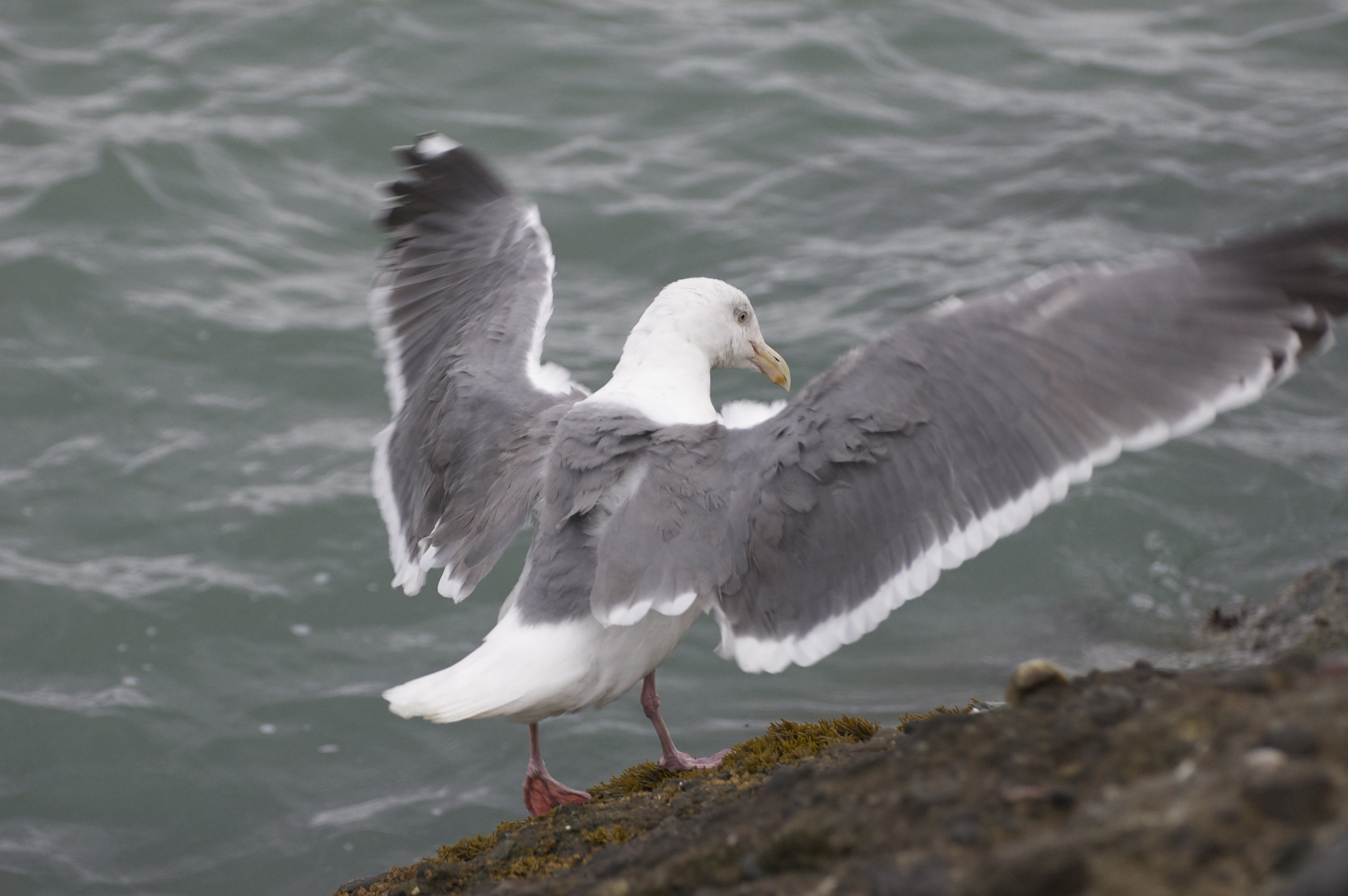
Last Tuesday the gull was released at North Jetty. Once out of the box, the bird took time to preen – which is how birds maintain their feather condition. Besides allowing flight, the feathers of all birds protect them from the elements. For aquatic birds this is particularly necessary – as warm blooded animals who live in the cold North Pacific need an impeccable array of feathers simply to surivive. Once satisfied that all was well, s/he launched from the rocks out over the inlet to Humboldt Bay and was gone.
There are many things you can do to help prevent this kind of injury to wild animals:
- Most importantly, if you fish, mind your gear. Try not to leave anything in the environment. Line, hooks, weights, all of these can produce fatal and torturous wounds.
- If you find derelict gear in the environment, remove it! Every hook removed from the docks, beaches and river banks is a hook we won’t ever have to remove from a bird’s mouth.
- Pass this information along!
- Support wildlife rehabilitation. Our ability to do this work depends directly on community support. BAX/HWCC is not funded by the county, state or federal governments. Your contribution makes our work possible. Thank you!
________________________________________________
Release Photographs!

HWCC/BAX volunteers prepare to release the Western Gull
——————————-
 Western Gull steps out to freedom
———————————-

Preening keeps feather at peak performance
—————————–

Tail feathers? check.
——————————–

Wings? check.
———————————

So long….
——————————-

Out over the inlet to Humboldt Bay and toward the North Pacific Ocean
——————————————-

S/he returns to a wild and free life
———————————-
 Good luck!
———————————
photos: Laura Corsiglia/BAX
Reference:
Gaston, Anthony J., Seabirds: A Natural History, 2004 Yale University Press