|
| With your help, we’ll have all the fish we need! |
Author: Monte Merrick

New video linked to GoFundMe!
var rand=Math.random ();var widgetproto = (“https:” == document.location.protocol) ? “https:” : “http:”; document.write(unescape(“%3Cscript src='”+widgetproto+”//funds.gofundme.com/index.php?route=widgets/typeb&d=9448&c=0&url=/yt4pk&t=7&v=”+rand+”‘ type=’text/javascript’%3E%3C/script%3E”));
Redwood Coast Brown Pelican/Fish Waste Response
Nearly 200 Birds in Care Contaminated by Fish Waste; Discharge Pipes at Fish Cleaning Stations to Blame

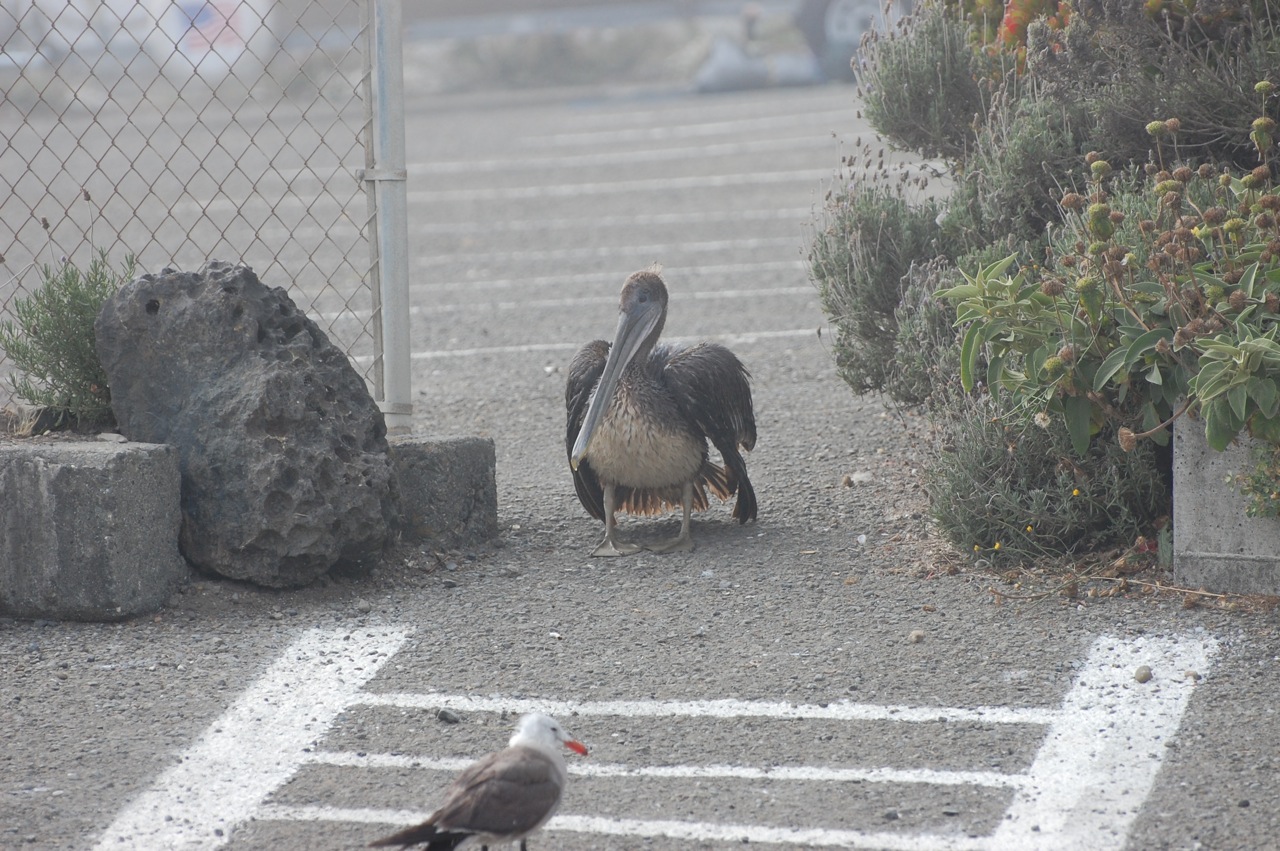
Since the last week in June 184 birds, almost all recently hatched Brown Pelicans, have been admitted for care by Bird Ally X at Humboldt Wildlife Care Center. All but three of these birds were contaminated by fish waste. While the rest of the West coast is seeing an unusually large number of Brown pelicans dying of emaciation – for reasons not yet understood – here on the North coast of California, Brown Pelicans and other birds face a different and more easily identified threat. Discharge pipes at fish cleaning stations in Shelter Cove and Crescent City are responsible for the contamination of hundreds of Brown Pelicans and untold numbers of gulls, primarily Heermann’s Gulls, who often forage and hunt with Brown Pelicans.
These birds are being doused in fish waste as they forage for scraps beneath the outflow of these polluting pipes. Fish waste and fish oil disrupt the feather structure that allows a seabird to remain dry and warm when entering the cold waters of the North Pacific. Without rescue they die.

Multiple incidents of such contaminations have been documented with photographs and video by Bird Ally X rescue crews in Crescent City and Shelter Cove.
California Department of Fish and Game code 5650 (a)(6) specifically states that it is illegal to allow to enter into State waters any material that “is deleterious to fish, plant life, mammals, or bird life.”
California EPA requires that fish waste from marinas be treated as waste water or sewage, not discharged into State waters.
 After much public pressure, Crescent City Harbor District (CCHD)has reportedly closed the cleaning station with this type of discharge pipe. Humboldt Bay Harbor Recreation and Conservation District (HBHRCD), which has jurisdiction over Shelter Cove’s fish cleaning station has yet to do so. Even now, more birds are being contaminated by this pipe.
These discharge pipes have injured hundreds of birds and killed many more. Biologist Deborah Jaques has said that over 50 pelican carcasses have been recovered. It is unknowable how many have died, or are yet to die.
 Pelicans and gulls killed by fish cleaning station discharge is not new to the North Coast. In August/September 2011 Bird Ally X at Humboldt Wildlife Care Center rescued 50 Birds from Crescent City and Shelter Cove suffering from the exact same problem.
Besides releasing 43 birds, Bird Ally X met with Harbor District officials and provided low-cost, easily maintained solutions. Both Cal EPA and US EPA recommend composting as a zero discharge solution to fish waste at public marinas and boat launches. Both HBHRCD and CCHD have had nearly a year to eliminate the source of pollution and stop killing and injuring Brown Pelicans and other wildlife.
As well as the cost paid by these iconic birds, nearly all of whom are still adolescents, less than 4 months old (Brown Pelicans can live 40 years), the costs incurred by Bird Ally X and Humboldt Wildlife Care Center, the only two permitted rehabilitators on California’s North Coast that can respond to this crisis, threaten our ability to continue as organizations. To date over 180 Birds have been brought into care and more are to come. Yet the Harbor District so far has refused to offer to cover any of the costs at all. This response could cost these organizations jointly over $100,000, not factoring in staff salary.
Volunteers to help with the labor-intensive task of rehabilitating this many large birds are vital to our success. Financial donations are also crucial. Each pelican eats 3-5 pounds of fish each day. That amounts to over $500/day on fish alone.
TO HELP:
visit
www.birdallyx.net
or
www.humwild.org
to learn more and to contribute to the care of these birds.
Contact the Humboldt Bay Harbor Recreation and Conservation District and Crescent City Harbor District. Demand that they stop illegally polluting California Coastal water and killing California Brown Pelicans. Demand that they pay their fair share for the care of the Pelicans they’ve injured.
HBHRCD – http://www.humboldtbay.org/contact/
CCHD – http://www.ccharbor.com/
Bird Ally X/HWCC inundated with Fish-oiled Brown Pelicans! Again!
 Along the West coast juvenile Brown Pelicans are flooding into rehabilitation centers and many more are dying on beaches and in bays and coves. At the end of June, as this years newly hatched birds made their way to the North coast, emaciated hatching year Brown Pelicans began coming into care here at Bird Ally X/Humboldt Wildlife Care Center from all of Humboldt and Del Norte counties.
Typically found disoriented no longer able to fly, initially this seemed like a normal occurrence – many juveniles don’t make it, and rehabilitators often provide supportive care for those who struggle, hoping to give them a second chance.

 Since we’d already heard that our colleagues in Morro Bay had 20 young BRPE in care, we began to prepare for a similar influx. By July 4 we’d treated a half dozen. On the 7th and 8th, however we began to get calls from all over – by the 9th we had 12 in care.

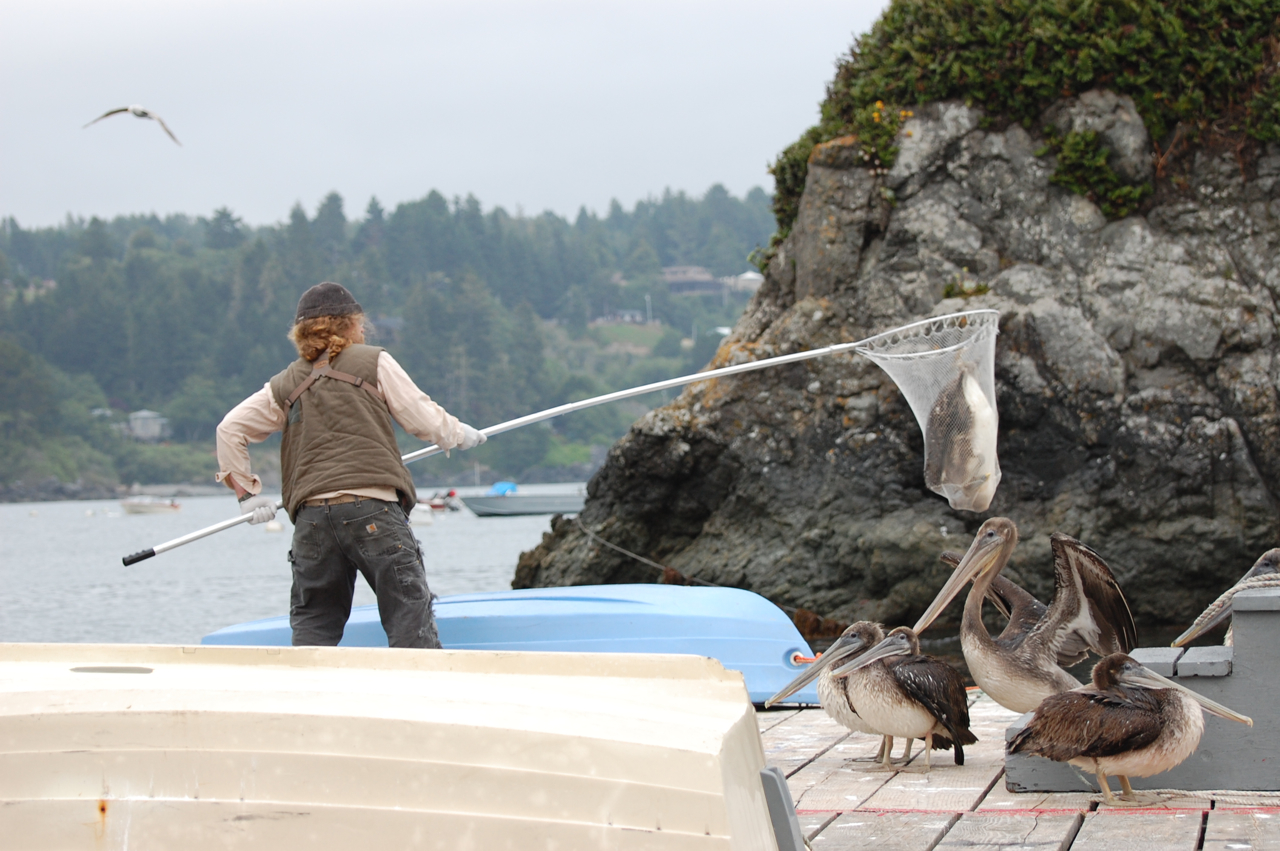
 9 July we received a call that several dead Brown pelicans were on Trinidad beach, perhaps as many as 12, and that there were a few sick looking birds that needed help. We went to investigate. I was very disheartened to see approximately 30 soaking wet HY pelicans in the water, on the rocks and on the fishing dock. We captured 9, took them to our facility at Humboldt Wildlife Care Center, and went back and captured another 9. The next day we captured 9 more.
As of now, we’ve captured 43 in Trinidad, as well as another 30 from around the North Coast.
But the situation has aspects even more grim. Witnesses in Crescent City have described ailing Pelicans (6 reported) being run down and killed with vehicles around the fish cleaning station.Department

12 July we sent a team to Crescent City to investigate the situation. Besides capturing 10 contaminated Pelicans, all juveniles, over 40 impacted birds were seen. Obvious contaminations occurred while they were there coming from the drain from a fish cleaning table that discharges into the harbor. Many birds were observed to have Salmon or Rockfish carcasses lodged deep in their pouches, after being fed by sport fishers.


 We’ve also received reports of impacted birds on Gold Bluff beach, above Orick. This will be a difficult location to access without permission from the NPS, although we’ve been invited to go out there with a commercial smelt fisher who doesn’t want the fisheries to take the rap for these injured Pelicans. This person has described what is likely to be feather lice as the culprit, and also believes these pelicans are somehow “tame.” He described them as suicidally diving into rough surf and being thrashed to the beach. Other fishers have described Brown Pelicans attacking their boats and “stealing” their anchovies.
We expect to start washing these birds tomorrow here at HWCC. While we were initially prepared for the idea of 60-100 birds, the reality is that we already have 70 and reports lead us to believe that another 60 would be easy to capture. If so, our facility will certainly be taxed, although I do feel that with support we can make it work.
here’s a recap of the numbers…
BRPE admissions since 22 June 2012
Fort Bragg – 2
Petrolia – 1
unknown – 1
Humboldt bay area -25
Trinidad – 43
Orick – 3
Crescent City -21
Shelter Cove – 5
Our urgent needs to care for these Brown Pelicans:
Financial help!!! Please donate using our Paypal button (our 501(c)3 is underway – your contribution will tax-deductible!)
We need help paying for:
FISH!!!!
Medicines
Operating costs!!
Volunteers: please call 707 825 0801 and let us know when you can come by!
Construction materials:
Lumber
Hardware cloth
Screws
Food for volunteers:
Healthy Snacks!
Rehydrating drinks!
Thank YOU!! We cannot help these birds without YOUR HELP!
Please Donate!
Brown Pelican T-shirts Released!
New Bird Ally X T-shirts are Here!


Laura Corsiglia’s beautiful design, hand-printed on a silkscreen donated by the nice folks at blackjack, this magnificent shirt adds a wild flair to your support of avian advocacy!
A nice chocolate brown with pale brown ink, in organic egyptian cotton the women’s v-neck comes in S, M, L and XL.
We also have crew neck in the same color, also organic egyptian cotton! in S, M, L, XL, and 2XL.
All shirts are $25 plus $3.99 S/H
To Purchase: follow this link to a page where the Buy Now button actually works!

| Sizes |
| SMALL MEDIUM LARGE XL |


| Sizes |
| SMALL MEDIUM LARGE XL 2XL |
Or,
please send a check for the amount of your purchase to:
bird ally x
po box 1020
arcata, ca 95518
become an ally of bird ally x! help support our work!
Just Published! An Introduction to Aquatic Bird Rehabilitation

An Introduction to Aquatic Bird Rehabilitation, a 150 page manual for wildlife rehabilitators, features a section on each aspect of caring for wild aquatic birds: Anatomy, Handling, Physical Examination, Captivity-related Problems, Feather Function and Structure, Waterproofing, Diet, Housing, and Release. With over 100 B&W and Color Photos, appendices covering common parasites, often used medications, and re-usable protective keel wraps, as well as a full glossary, this manual is a first of its kind. With examples intended for the novice or experienced rehabilitator, and with suggestions to meet any budget while still providing quality care.
Written by rehabilitators with extensive experience with all wildlife and who are specialists in aquatic bird care, An Introduction to Aquatic Bird Care is meant for you, the wildlife care giver.
“Wow! Where was this book 20 years ago when I started working with seabirds?! But then again, many of the techniques described in this manual hadn’t been developed back then. An Introduction to Aquatic Bird Rehabilitation is what the title says–and so much more! This is a “must have” reference book for anyone working with aquatic birds…whether just beginning or a veteran to their care, the book contains a wealth of information on examining, evaluating, treating, housing, feeding, waterproofing, and releasing most aquatic birds. The generous use of photos and diagrams to illustrate procedures, clear section headings, and many handy reference tables make this a very user-friendly manual. The new appendix containing a glossary, drug dosages, and a parasitology section complete with life cycles is itself an invaluable resource. Congratulations to our colleagues at Bird Ally X for creating this book!” Erica Miller, DVM, Tri-State Bird Rescue and Research
An Introduction to Aquatic Bird Rehabilitation
copyright © 2012 by Bird Ally X
Published by Bird Ally X, a nonprofit organization dedicated to
Helping Wild Birds and the People who care for them.
PO Box 1020
Arcata CA 95518
Authors:
Bill, January O.
Corsiglia, Laura
Masvidal, Vann
Merrick, Monte
Riggs, Shannon M., DVM
info@birdallyx.net
ISBN 978-0-9851805-0-8
If you’d rather not use PayPal, then send a check for $38 plus $3.99 shipping and handling to:
Bird Ally X
PO Box 1020
Arcata CA 95518
Bird Ally X winter/spring 2012 – our first annual newsletter!
BAX end2011 newsletter
var docstoc_docid=”110539711″;var docstoc_title=”BAX end2011 newsletter”;var docstoc_urltitle=”BAX end2011 newsletter”;