Eat Delicious Chocolate, Save Wild Animals in Trouble

Humboldt Wildlife Care Center’s chocolate tradition gets a re-boot!

For many years our chocolate bars have been available around the county with all proceeds going toward the care of injured and orphaned wild animals… well, now a local chocolatier (Thank you Sjaak’s in Petaluma/Blue Lake!) has teamed up with Bird Ally X to bring new flavors and an informative label to help us treat your sweet tooth while you support our work!

chocolate-2

With labels designed in house by BAX art director, Laura Corsiglia, and with new flavors that are “wildly delicious” it’s now tastier and more interesting than ever to support your local wildlife rehabilitators and advocates. Plus, our new chocolate is certified organic, fair trade and vegan! Look for our new chocolate bars in area stores or stop in to our clinic in Bayside and get one or five today! (or tomorrow, or the next day…)

chocolate-4 chocolate-3


Share

Mallard Mothers Want Your Help.

Helping Wild Mothers on Mother’s Day (and every day)

mallard 2015 - 2

This year’s Mallard babies at HWCC. We have two dozen mallard babies in care already!


Every year wildlife rehabilitation facilities admit huge numbers of orphaned ducklings for care. In California, Mallard ducklings top the list annually for numbers brought in to our state’s permitted rehabilitators. This amounts to tens of thousands of young Mallards each year who are raised by people instead of their mothers.  The number of ducklings who die without being found is unknowably large.

The most common cause of separation is the death of their mother. Often, Mallard nests are far from water, safely hidden. But the journey to a pond, stream or river bottom that a mother duck must lead her babies on is fraught with hazards, and human activity is the most dangerous.

Automobiles and dogs are the primary reason the mallard ducklings are brought to our facility on Humboldt Bay. Humboldt Wildlife Care Center, because of our rural location, sees far fewer ducklings than facilities in San Francisco, Sacramento or the Los Angeles area, but still we get over two dozen each year.

So how can you help? There are many ways!

See Wild Animals:  Wild animals of all species need to be able to move from one area to another. Our complex of roads and highways makes simply getting around the world a life threatening activity. Watch out for wild animals. Don’t hit them with your car!

Contain and Control Your Pets: Wild animals have natural rights to live and thrive on Mother Earth. Be a responsible pet owner and don’t allow dogs and cats to roam unattended. The fawn your dog brings back to the porch, or the ducklings who are orphaned when your dog attacks the mother, songbird babies left behind from your house cat’s carnage would have fared much better if left to live and learn form their mothers.

Share the Wonder of Nature: Wild nature, of which we are a part, is a beautiful mystery. Happiness depends on our participation in this wonder. Wild animals have better chances when they are loved and respected by the humans who share their world. Be sure to love from an appropriate distance, though!

Help Wild Animals Caught in Society’s Traps: If you see a wild animal in trouble, call us! 707 822 8839 If you have a conflict with a wild animal, call us! If you have time, volunteer with us! If you have money, help us pay for our wild patient’s care. The injuries that our human world causes to wildlife is OUR problem. Help us fix it!

Juvenile Mallards in our specially built Waterfowl Aviary enjoy their duckweed!

Thank you for a being of our lifesaving work!


Share

Black Phoebe Fledgling Home Again!

Spring is in full swing now and wild babies are showing up in the world, getting found by kids, cats, dogs, and other suburban challenges!

Last week, a youg Black Phoebe, fresh from the nest, was found by students on the ground at East High, an alternative high school in Fortuna. Brought to our clinic, we quickly determined that the young bird was a fledgling, not injured. Although songbirds live among us, closer than almost any other wild animals, many people remain unaware that fledgling birds often spend up to a week not quite ready to fly, but more than ready to jump form the nest. This is a very vulnerable time for these little guys, but it’s a time that every adult bird you see has passed through. Of course our modern world, with housecats, dogs, and cars lurking behind every moment, presents some dangers that natural life on Earth doesn’t, but still the best place for a fledgling bird is with her or his parents.

After giving this Phoebe an exam and some food, we started to arrange for the best possible plan – reuniting the family.

Black Phoebe eating mealworms while in our care ………..   (video BAX/Lucinda Adamson)


Two days later, we took the little Phoebe back to Fortuna, back to the exact location where s/he was found. Adult Black Phoebes were flying all over the area. A hole in the wall of an outbuilding appeared to have a Phoebe nest. Our staff placed the young bird as close to the nest as possible, off the ground and hopefully out of danger.


BLPH re-unite 5:1:15 - 05Black Phoebe adults in flight – are these our guy’s parents?                                (BAX/Laura Corsiglia)


BLPH re-unite 5:1:15 - 01The young Phoebe sits waiting for parents.                                                                         (BAX/Laura Corsiglia)


Soon the youngster made a short flight to the roof of the building. Almost immediately an adult approached. Success! Soon the fledgling’s parents were bringing food. We stayed to make sure that all was well and then left this wild family to their own world, right out in the open, in the middle of our world, yet so mysterious!


BLPH re-unite 5:1:15 - 10

BLPH re-unite 5:1:15 - 11

BLPH re-unite 5:1:15 - 29

BLPH re-unite 5:1:15 - 31

Thank you for supporting our work! Your donation goes directly to our efforts to provide care for injured and orphaned wild animals, and to promoting co-existence with all of our wild neighbors. Please share our work, and if you can, donate today!


All photos (BAX/Laura Corsiglia)

Share

Merry Maloney, NorthCoast Wildlife Superstar!

merry with Al

by January Bill, Bird Ally X co-founder

I was watching a Red-shouldered Hawk perched on a snag outside my window the other day. My 4 year old son pointed him out to me, commenting on how he blended in with the plants. I immediately started thinking of a friend and well-known community member, Merry Maloney. In truth, I think of Merry every time I see a raptor in the sky or when we are rehabilitating one at the Humboldt Wildlife Care Center because when I first met Merry her passion for wildlife drew me to her. I was lucky to have worked with her almost daily for years doing wildlife rehabilitation in Humboldt. Her knowledge, inspiration, and humor helped keep me on my path to a life devoted to a career in wildlife rehabilitation.

You may know her, she is an exceptional person all around and is active throughout our community, but I would like to share with you the world that I know her from, and that is wildlife rehabilitation. Once she retired as a school nurse in her first profession, she began her second career as a volunteer with the HWCC in 1999 as the Education Team Leader and Raptor Rehabilitator. She opened up her and her partner Barb’s (who has supported her every step of the way) home for housing HWCC’s educational wildlife ambassadors. This was an extremely selfless act and was also a huge personal and financial commitment. Most of the wildlife ambassadors continue to live and be cared for on their property.
Merry attended international conferences and networked with national raptor rehabilitation organizations to ensure stellar care was given to the local injured and orphaned raptors in her charge, giving hundreds of individuals, from Bald Eagles to baby Quail, a second chance at a wild and free life.

She developed and presented over 1,000 educational presentations to schools (preschoolers to grad students) and many community organizations, never turning down an educational outreach opportunity. Recently Merry had to retire from the work to which she had devoted her life because of her health. Yet her devotion to wildlife, to the environment, to children and wildlife education continues on through the work of BAX/HWCC’s staff, volunteers and interns, and all who have been inspired by her to be wildlife stewards of our shared world.

Merry Maloney is a true wildlife advocate and hero in our community. For all of her contributions to the HWCC and our community, we honor her by naming our recently-built raptor conditioning aviary the Merry Maloney Raptor Flight House.

Merry, thank you for doing this life saving work. Thank you with all of our hearts for everything you have done to make this world brighter for both the people and wildlife. We love you.

merry and carson
Merry with Carson, an unreleasable Peregrine Falcon, named for Rachel Carson. (photo: John Griffith)

Share

Northern Fulmars, seabirds of mystery

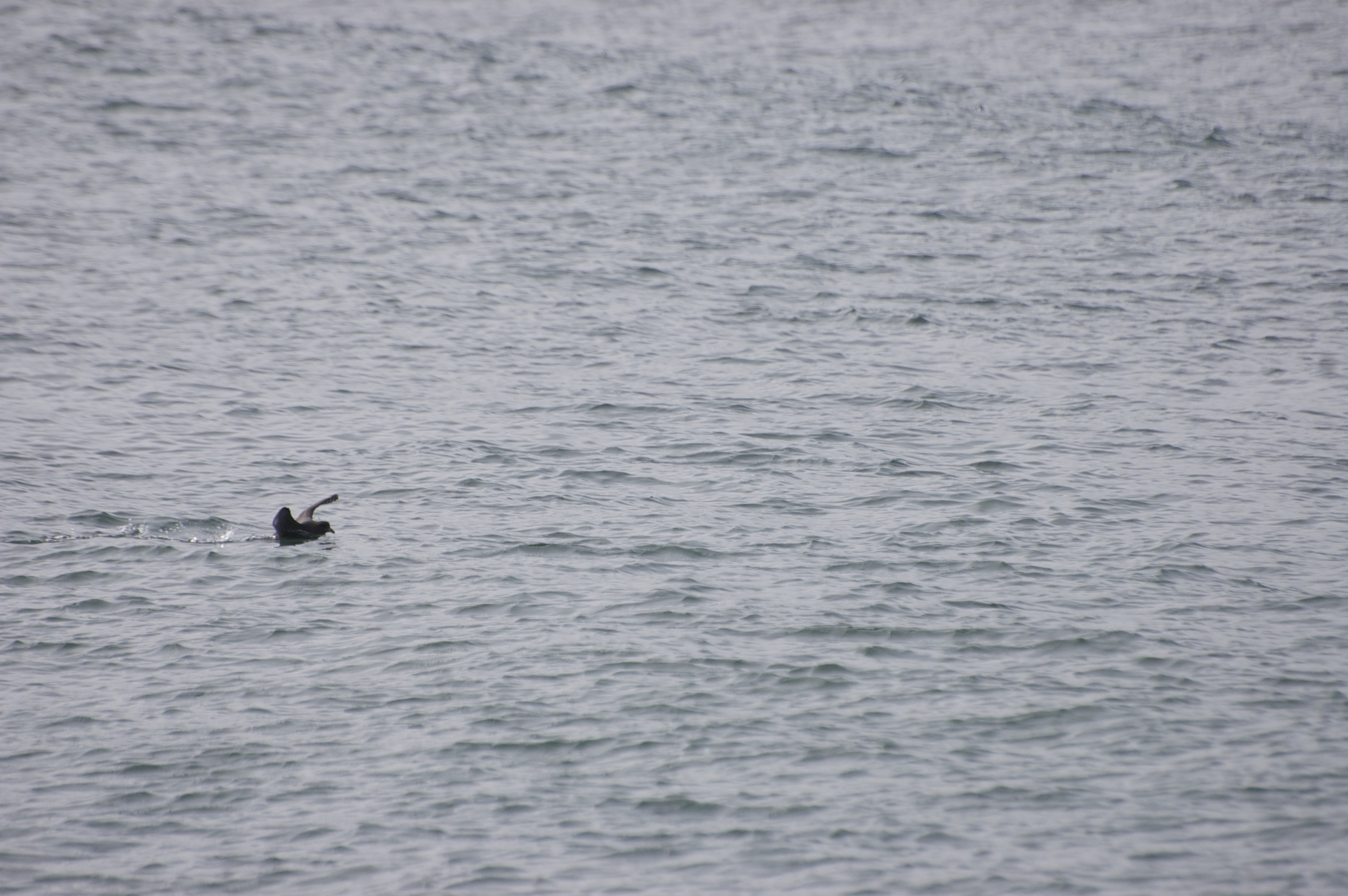
NOFU 2014 - 05-clear-background-copyfrom the Bridge of a crabbing Ship
in the middle of the night on the southern Bering sea –
Wakened by the Rolling Sea.

it is december and in a locker on board
hang orange suits Meant to
Protect human Life
should the Vessel go Down.

otherwise, says the pilot
we have five minutes at Most
before we Succumb to the Cold
and we Drown –

the Bow points to the Sky,
then down into the Trough
the lights cast a wide arc and we see
peppering the Crests,
Heads Tucked, at rest
northern Fulmars,
common Murres, asleep.


Northern Fulmars (Fulmaris glacialis) are mysterious birds. Their pelagic lives rarely intersect our land-locked habits. When they do come ashore, to rear their young, they choose remote sea cliffs at the edge of ice-covered oceans. At sea, because they follow the fishing industry’s floating slaughter-houses, perhaps those who know them best are whalers and commercial fishers.

Infrequent visitors to land, they are less commonly admitted for care than other seabirds who stay close to the coasts. As with all tasks, increased exposure improves our skills. So for many years, Northern Fulmars were regarded as a difficult species to treat, and many of these birds died while in our care.

When caring for a wild animal, besides treatment for whatever the injury or condition, the primary care given is husbandry, which amounts mostly to diet and housing. When we tried to find how to provide better care for fulmars, these are the areas we had to study.


NOFU 2014 - 01

NOFU 2014 - 03
Early in treatment, in a small tepid salt pool. The environment is meant to be stress-free.


Northern Fulmars eat anything – aquatic invertebrates like krill, small fish, squid. And they live on the open ocean. While their habitat is impossible to recreate, it still is relatively simple. Open sea.

In late fall of 2003, there was a Northern Fulmar wreck (a seabird wreck is an unusual mortality event involving large numbers of the same or mixed species – while these have occurred throughout time, warmer oceans, acidified oceans, and nitrified oceans are playing an increasing role) in which hundreds of these birds were beached from Baja to British Columbia… sadly very few birds were released. Most facilities did not have proper pools and lacked experience. Along the coast, most birds died.


NOFU 2014 - 10
Evaluating feather condition and ablity to stay dry in water, or waterproofing…


At the facility where I was the care manager, we realized that our diet, established to provide high calories without fat, so that oils wouldn’t contaminate the pool, was not merely not helping, but was actively harming the birds, who were dying, several a day. We switched to a fish-based diet, and immediately, birds began to respond. We managed to release 7 of the 75 in our care. While we were encouraged by our improvement, still this was a dismal result.


NOFU 2014 - 08

NOFU 2014 - 12
Regular examinations and blood tests allow us to track the patient’s progress.


In 2007, along the coast of Monterey Bay, another Fulmar wreck occurred – much smaller in scope, only birds in the bay were affected, not the whole coast. Still we had 140 birds in care! We were seeing similar results, roughly 10% of the birds were looking good, appearing to be headed for release.

By coincidence, the facility we were using had seawater pools that were available for Sea Otters. Because of the large numbers of birds in care, we had to use these pools as well. Imagine our shock when nearly all the birds on seawater suddenly became voracious eaters, vocalizing and highly active. While we had no physiological reason for these birds not thriving on freshwater (many other seabirds do fine on freshwater while in care) our eyes told us all we really needed to know. Northern Fulmars require salt water.


NOFU 2014 - 11

NOFU 2014 - 06

NOFU 2014 - 09
NOFU 2014 - 07
As their health improves, a larger salt pool and far less handling are required for continued recovery.


So last month, when we got four fulmars in from local beaches in Humboldt County, the first thing we did was salt our pools. In fact, our pools are built with pumps that allow us to switch back and forth between salt and fresh water for just this reason. We use salt for all pelagic birds now – while it is more expensive to add salt to a pool, certainly, but salt, especially for Northern Fulmars, is the difference between life and death.

Your generosity supports innovations like these. Without you we would not be able to provide the best care we can, and “push the envelope” to improve, to learn, and to be able to save more wild lives. Thank you so much for making our work possible. Scroll through the following pictures of our Northern Fulmars recently in care… and when you feel good about their release, please, feel free to feel good about yourselves for helping to make it happen.


Release!

NOFU 2014 - 13

NOFU 2014 - 15
NOFU 2014 - 18
NOFU 2014 - 19
NOFU 2014 - 21NOFU 2014 - 20
NOFU 2014 - 25
NOFU 2014 - 23
Rehabilitator Lucinda Adamson (left) and wildlife student/volunteer Lisa Falcao watch their patients fly away.


NOFU 2014 - 22
All Photos: Laura Corsiglia/Bird Ally X

Share

Western Grebes Need Your Help

Young birds, tossed by big seas, struggle on area beaches. Over 50 Grebes rescued so far! Bird Ally X/Humboldt Wildlife Care Center needs your help providing these birds a second chance.


Grebes Autumn 2014 story - 11
Western Grebes, elegant and graceful, recover in our seabird pool


During the second week of October a period of rough ocean conditions began on the North coast with breakers higher than 16 feet. Immediately Humboldt Wildlife Care Center/BAX began admitting immature Western Grebes who had been tossed on the beach by the big waves.


Grebes Autumn 2014 story - 17
A young Grebe in a transport carrier. Eye protection is a good idea when handling these birds!


To date, we have admitted 50 of these elegant black and white birds for care. All of them are young birds. Western grebes raise their families all over the west on freshwater lakes. Once their young can fly and hunt for fish on their own, they depart the lakes to spend the winter along the coast on bays, inlets, river mouths and on the open ocean, often seen just beyond the break in large groups called rafts.


Grebes Autumn 2014 story - 16
Checking body condition: many of our patients are emaciated.


Young birds who are unfamiliar with the ocean can struggle with storms and high seas, leaving them vulnerable. A few days of not being able to eat and they may find themselves too weak to recover on their own. Add to this mix the modern challenges of unpredictable ocean health due to a disrupted climate, overfishing and the pollution stream that comes from all sides, and the near-shore environment can now be seen as a much less hospitable place for young seabirds.


Grebes Autumn 2014 story - 22
Blood is drawn for simple tests that can help us determine the overall health of each bird.


Once in care, all oceanic birds require resource-intensive treatment. Each bird eats a pound of fish a day! Rehydrating fluids, anti-parasite medicine and nutritional supplements also are needed.

After millions of years of evolution, Grebes are unable to tolerate being on land, or any hard surface, and must quickly be housed in pools. Clean water is absolutely necessary for their recovery. We conserve our resources as much as we can, but we still need your help providing these fundamental necessities for our patients.


Grebes Autumn 2014 story - 15
A slightly warmed pool helps weakened Grebes get back on water – a must if they are to survive.


Grebes Autumn 2014 story - 13
Each bird eats about a pound of fish a day.


Grebes Autumn 2014 story - 08
Some tossed fish encourage our patients’ appetite while in the stressful captive environment.

Grebes Autumn 2014 story - 09
Fortunately Western grebes are highly social and prefer to be with others.


DSC_0615
Once healthy, the young birds are released into Humboldt Bay, where many species of prey-fish are abundant.


Grebes Autumn 2014 story - 20

Grebes Autumn 2014 story - 21


Thanks to community support we have released 18 of these birds back into the wild. We still have 14 Western Grebes in care who need you to help cover the costs of their ongoing treatment. A few more are admitted each day. Please give what you can.

Our mission to help individual animals survive against the challenges modern society has placed on the natural world is only possible with your support. As you scroll through the photographs of our patients, you can enjoy knowing that your contribution provides the best care available for struggling wild animals here on the beautiful Redwood Coast. Any amount helps. Besides financial support you can also help spread our work by sharing this page. Invite us to present at your club or organization. We love to talk to our community about wildlife and how we can all help. Contact us at info@birdallyx.net!


Print
all photographs Laura Corsiglia/BAX

Share

Can You Help?

Each year BAX/Humboldt Wildlife Care Center raises a certain amount of money. Without this money we could accomplish nothing. Our supporters make a big difference everyday in the lives of injured and orphaned wild animals.

Food for our pateints.
Medical supplies.
Patient housing.
Water.
Electric.
Gas for rescues across our huge geographical area
Small stipends for our most critical staff.

These are the direct costs of helping individual wild animals and wild families. We also advocate for wild animals in an effort to shift public policy toward peaceful co-existence with our wild kin. Producing workshops and educational materials for wildlife rehabilitators is another way that we work to improve the conditions and ameliorate some of the negative impacts our society has on wild animals.

Your support is critical to these efforts. And we need your support now.

This year we’ve had more wild patients brought to us than ever. Now we need your help more than ever. After a very taxing Spring and Summer we need help now recovering from our costs. We need help making the needed repairs to our facility. We need help paying our water bill. This is the very ordinary, very work-a-day, real word of direct animal care. Loving wild animals means providing clean water for pools. It means laundry soap. It means late nights writing letters to our policy makers. We express our love for baby wild mammals with food that will help them grow and learn what it means to be a a wild and free adult.

Help us grow so that we can provide for all of Northern California’s wildlife. Help us build our Aviary in Manila specifically for pelicans and other large seabirds. Help us provide the kind of professional staff our region’s wildlife needs and deserves.

Please donate. Please.

Thank you for being a part of this life-saving work.
comu ask

Share

Unified, to better serve Wildlife

Bird Ally X/Humboldt Wildlife Care Center are one wildlife service organization!

This is such an important occasion for us! After 3 years of partnership, BAX/HWCC have merged our distinct organizations in to one to better use our resources and be more effective at meeting our mission. We are excited and optimistic for this opportunity to expand our capacity to meet the needs of injured and orphaned wildlife on California’s North Coast and beyond and to practice and teach proven best practices and foster advances in wildlife rehabilitation.

As the region’s only permitted all-species wildlife rehabilitation clinic, we serve an enormous geographical area, covering nearly 20,000 square miles. Extending from northern Mendocino County to Curry County, Oregon, and east as far as Weaverville in Trinity County, our responsibility to provide care for injured and orphaned wildlife is weighty.

This region is more than simply large, however. Radiating out from our clinic in the heart of the Jacoby Creek Watershed through the ancient Redwoods, the dune forests, the near shore ocean, and the mountains to the east, our home-place is a potentially critical refuge. As the reality of climate change takes hold, it is becoming apparent that temperate North American rain forest – stretching from here to Alaska – may be key for many species’ survival. As a committed ally of the wild, BAX/HWCC doesn’t take this lightly.

A sense of urgency is growing in communities everywhere, that we must act now, and with intelligence, if we are to preserve ourselves and our wild neighbors.

In these shared current circumstances, joining together makes sense.

Unquestionably, a major component of protecting wild animals from injury and keeping their families together is to advocate for and practice place-based, energy-aware wildlife care.

BAX/HWCC, with your support, is able to provide leadership and innovation as we accept the challenge of making true progress for our relationship with our wild neighbors, especially as viewed by the generations that will follow ours. Together we match extensive professional wildlife care experience – from around our state, our country and our world – with the rooted knowledge and deep affection long time residents of our region have for our home.

Bringing familiarity with “state of the art” facilities, combined with the organic know-how, responsible husbandry and sustainable practices needed to reduce waste and repurpose the material wealth of our world, BAX/HWCC offers a possibility for the future of wildlife rehabilitation that is adaptable and resilient in uncertain times.

Most importantly, and most practically, this union allows us to streamline our efforts at outreach and education. Encouraging co-existence with our wild neighbors is as important as providing quality rehabilitative care. Because we reach out to a diverse community, our message of humane solutions for human/wildlife conflicts is one of our most effective forms of animal care!

As one entity our materials and programs can be efficiently designed and the burden of costs can be jointly shouldered. Our ability to ensure that the overall community is aware of the services to wildlife we provide will be enhanced by this streamlining as well. We look forward to producing more quality materials for schools, agencies and organizations.

We also will be “rolling out” our new website by the end of the year with expanded resources, thanks to support from the McLean Foundation and the Humbodlt Area Foundation.

There is, in short, a lot of work to be done. Against all our modern catastrophes, hands are needed everywhere. At Bird Ally X/Humboldt Wildlife Care Center we are committed to the rescue, rehabilitation and release of injured and orphaned wild animals. We believe that no matter what crises we face, these individual animals whose lives are disturbed by the industrial world, will always deserve the best available care.

Thank for your support of our organizations in the past, and for helping us reach this exceptional place. Now we ask for your continued support as we embark on this new era.

With warm appreciation,|
The Board, Staff and Volunteers of Bird Ally X/Humboldt Wildlife Care Center

Share

In Wildness is the Preservation of Raccoons, In Raccoons is the Preservation of the Wild

PlayPlay

Raccoon (Procyon lotor) babies have a lot to learn. As adults, Raccoons hunt and forage for a wide range of food, from songbird eggs to berries to the salmon a bear leaves behind. Raccoons hunt small rodents, crunch on snails, and nibble the mushrooms on the forest floor. Raccoons are brave, resilient, adaptable and notoriously intelligent.


first raccoon release 2014 - 021
Orphaned Raccoons in their housing, prepare for the wide and wild world. To help them recognize the real world when they see it, we’ve provided them an artificial river of concrete. We call it the Los Angeles river. No substitute for an ecosystem, but at least they know to look for fish in moving water.


Raccoons have lived in North America for millions of years. This familiar wild neighbor has nearly as many names as there are indigenous languages. We use the Algonquian name, derived from arahkunem – which is said to mean “scratches with hands.”(1) Locally, in Wiyot, the animal “with the painted face” is known as jbelhighujaji (pronunciation).(2)

For a glimpse into their place in the ecology of Northern California, a Shasta story has Coyote and Raccoon living together each with five children. When a jealous rivalry ends with Coyote killing and feeding Raccoon to his children, one of Coyote’s sons tells Raccoon’s orphans what happened – they decide to kill all Coyote’s pups but the one who told them. Afterward they flee with the spared pup into the sky. Coyote tries to follow but cannot keep up. The six young animals become the Pleiades, high above in winter when no raccoons are about, and down from the sky in Spring and Summer when raccoons emerge with young.(3)


first raccoon release 2014 - 029
Taken to a remote tributary of a nearby river, rehabiliator Lucie Adamson and volunteers prepare to release the season’s first six raccoons back into their wild freedom.


first raccoon release 2014 - 046
Taking their first tentative steps into a world without walls. As kits, as soon as they began eating solid food, they were offered fish, mushrooms, plant material, small rodents, small birds, vegetables, fruit, eggs and insects, hidden under rocks and logs, hanging from branches. They know where to look for food.


It isn’t frivolous to consider the seriousness of raising orphaned babies of a species this complex, this storied, this ordinary, this mysterious. Here we are, as removed from “universal nature” as any species has ever been, yet it’s up to us to provide an education for these wild young things.

When we commit to the care of a wild orphan, we accept the responsibility for their wild education. To teach a wild baby to be wild requires an inhabiting imagination. We must see the world this young animal will see, and then provide the challenges that will teach the skills necessary to thrive in that world.

When we commit to the care of a wild animal, we are committing to the wild, to nature – we are accepting Nature’s terms – we are accepting, and in fact seeking, the blaze of reality. This is, as they say, a tall order.


first raccoon release 2014 - 054
Young, healthy and in a lush and resource-filled environment, these orphans will soon find out they are home.


Meeting nature’s terms does place the rehabilitator in an awkward position. Our towns, our cities, ranches, forestry, fisheries, in short, nearly all of modern society struggles to co-exist with the wild. Promoting co-existence with wild animals – this alone puts a person outside of most of society’s concerns.


first raccoon release 2014 - 070
Just released, this Raccoon finds something to eat right away.


To be an ally of the wild often puts a wildlife caregiver in opposition to the general dreams and desires of our human neighbors. Schools, shopping centers, highways, solar farms, windmills, none of these, no matter their merits, is a boon to the wild. Even though any of these promises to preserve the world, a wildlife rehabilitator doubts the proposition.

Experience, or maybe intuition, knows that people don’t preserve ‘the Wild.” The wild is the expanding universe and the cosmic sweep of galaxies, it’s the comet’s eventual return, the dividing cell, the grasp of the leaf cutter beetle, the gill, the hoof, the photosensitive tissue that finds these words on the screen. We see the strip mine, the copper mine, the mountain top removed for the coal beneath – the old forest destroyed – the old forest re-named “overburden.” Factory trawlers scraping the bottom of the sea, oil spilled from exhaust into the suffocating sky – it’s hard to believe that modern society will preserve anything.


first raccoon release 2014 - 036
After nearly four months in care, a young Raccoon explores a real river for the first time.


first raccoon release 2014 - 037

first raccoon release 2014 - 032
Reaching the opposite shore.


Henry David Thoreau, in his essay “Walking,” offers what could be the wildlife rehabilitator’s complete philosophy, in eight simple words: “in Wildness is the preservation of the world.”(4) This statement is irrefutable. In some ways it is shocking that it had to be uttered. To rehabilitate wildlife, rehabilitators live by this simple truth, its utter grace and its razor sharp accuracy.

Everything emanates from the Wild. What else can the wild be if not the headwaters of existence? The wild could be called the real. We may as well say that in reality is the preservation of the world – not in law, not in hybrid automobiles, not in aqueducts, not in theology. The real presents itself. Wild allies follow as we can.

This year, at Humboldt Wildlife Care Center, BAX staff and volunteers have been caring for two dozen orphaned Raccoons. Our first litter of four, whose mother had been trapped and dumped miles away, came the third week of May. They were nearly three weeks old. Last weekend we released six youngsters who were ready to go. We still have over a dozen in care.


first raccoon release 2014 - 080
With startling speed the Raccoons dispersed into the forest.


first raccoon release 2014 - 049 first raccoon release 2014 - 078
It can be difficult, as caregivers, to prepare our charges to one day climb much higher than we ever could.


Each of these youngsters is learning to hunt, to forage, to climb, to hide when threatened. Each of these youngsters is fierce and determined. Healthy in mind and body, we release them into a carefully chosen site. Food must be present. Water, too. Cover against predators (Coyote is still looking for Raccoon) must be available. Room to roam – these animals must be able to disperse from this site, preferably adjusting to freedom and autonomy before encountering a backyard and the get-rich-quick scheme to be found in humanity’s garbage pails.

For the release, the six Raccoons were weighed, examined and put into transport carriers. We drove them to a remote location on a tributary of a nearby river. Once the carrier doors were opened, five of them sprung into action, heading for the river and swimming across to its other bank. Some climbed trees, others immediately searched for and found food (food we’d put there, but nothing like early success to build confidence!).


first raccoon release 2014 - 091
One Raccoon was more cautious. Our release team moved back from the site and waited.


first raccoon release 2014 - 086first raccoon release 2014 - 103
At last, confident that the coast was clear, S/he left the carrier behind.


first raccoon release 2014 - 065
Forest riparian habitat is excellent for Raccoons. And it didn’t take this group long to figure that out. Now they’ve entered the real world. Will each survive and live long lives? No one knows. What we do know is that we’ve given these young wild kin the best chance we could.


One Raccoon hung back, not leaving the relative safety of the known carrier, poking her head out, ducking back in. Our team moved back and waited. Eventually, after many hesitating starts, she left the carrier and quickly disappeared into Reality.

first raccoon release 2014 - 060

All good things are wild and free. – Henry D Thoreau


Your contribution makes the care of orphaned Raccoons, and all of our wild neighbors who need our help, possible. Please donate. Thank you for being a part of our life-saving work.

Print

All photos: Laura Corsiglia/Bird Ally X

(1) The Rice University Neologisms Database, ‘coon’, accessed 27 September 2014

(2) http://www.wiyot.us/language, accessed 27 September 2014

(3) Shasta and Athapascan Myths from Oregon, Livingston Farrand and Leo J. Frachtenberg: The Journal of American Folklore Vol. 28, No. 109 (Jul. – Sep., 1915) , pp. 207-242

(4) Walking, Henry David Thoreau, The Atlantic, June 1862
Share