Release the Mallards!

mallard release 2014 - 5

Every year in California the number one bird species brought to wildlife rehabilitators for care is the Mallard.

Whether you think of the bright green heads of the males or the lovely brown females, Mallards are the iconic duck of North America.

At Humboldt Wildlife Care Center we raise many orphaned goslings and ducklings each Spring and Summer. By far, Mallard ducklings are our most frequent patient, too.

Mallard mothers build nests in many locations, often in our own backyards, but perfectly hidden. When her eggs hatch, unlike songbirds, her ducklings are already fuzzy with down and able to follow her to water to feed. Momma Mallard’s task is to keep her babies warm and safe and show them how to find the good food (Duckweed!)

Unfortunately there are many obstacles between the nest and the water. Along the way sometimes a few ducklings might become separated from the family group – by cats, dogs, kids, streets and roads and more.

And that’s where we come in. At Humboldt Wildlife Care Center we have an aviary built especially to take care of pond-loving birds like Mallards. While in care we provide them with all the duckweed they can eat.

mallard release 2014 - 1

mallard release 2014 - 2These ducklings get their first taste of freedom since they hatched over 6 weeks ago!

The three ducklings we released last Wednesday were brought in over 6 weeks ago. Now they are old enough to keep themselves warm, stay out of trouble and find their own food.

At our nearby marsh there are ponds perfect for ducklings. Many Mallards and other birds already take advantage of the plentiful food and relative safety that our marsh provides.

mallard release 2014 - 3

mallard release 2014 - 4The Arcata Marsh: A duckweed smorgasbord!

If you’re looking for something awesome to do, head over to the Arcata Marsh and check out all the birds and wildlife. Who knows, maybe you’ll see these three Mallards. Thanks to people like you who support our work, these young birds are truly lucky ducks!

mallard release 2014 - 8Happy rehabilitators glad to see these Mallards return to their wild and free lives!

Your Donation Saves Wild Lives! Please support our work. Click on the donate button to make a tax-deductible contribution. Thank You!

Print

(All photos: Laura Corsiglia/BAX)

Share

Friday the 13th a ‘lucky’ day for this Peregrine Falcon

PEFA release 14 June 14 - 06


Usually when a call comes in to Humboldt Wildlife Care Center, our clinic in Bayside, about a bird of prey who’s been struck by a vehicle, it doesn’t end well. So when the kind man who stopped to scoop up a Peregrine Falcon from Myrtle Avenue last Friday (the 13th) pulled up to our door, wildlife rehabilitator Lucinda Adamson was hoping for the best, but prepared for the worst.

Lucinda greeted the rescuer and went out with him to his truck.

Inside the covered bed, the falcon had gotten loose and was trying to fly.

“The rescuer called on his way to say the bird must have only been stunned,” Lucinda recalled, “he asked me, ‘should I just let him out?’ – I said no bring the bird in… might as well check him out.”

Lucinda had to get the falcon from the truck with one of our aviary nets. While the rescuer provided some basic information, she gave the bird a quick exam to see if he could be released.

Peregrine Falcons, like Bald Eagles and Brown Pelicans, were nearly extirpated in the United States due to exposure to the pesticide DDT. While other factors, such as wanton killing and habitat loss, contributed to their vulnerability, banning DDT and offering the protections of the Endangered Species Act allowed the world’s fastest animal(over 240 miles per hour!) to survive.

Peregrine Falcons were removed from the Endangered Species list in 1999.

While the population is on much better footing now, threats to individual birds still remain. Gunshot, fishing line entanglements, and vehicle strikes are common causes of injury to these birds.

This falcon, most likely a male judging from his relatively small size, was first seen in the road eating a dove. The bird’s rescuer said it caused him concern so he turned around to check on him. When he passed again the falcon was splayed on the pavement. Seemingly dead, he was easy to pick up.

PEFA release 14 June 14 - 01Lucinda Adamson, HWCC/BAX Wildlife Rehabilitator, checks the weight of the lucky Falcon (photo: LCorsiglia/BAX)


Remarkably, upon Lucinda’s intial examination, no bones were broken. The only thing amiss was a small amount of blood in the bird’s mouth, possibly belonging to the dove. She decided to keep the bird in care for observation and further evaluation. After receiving a mild anti-inflammatory and fluids, the falcon was placed into his temporary housing. Immediately he was attempting to fly from the small enclosure.

PEFA release 14 June 14 - 02An exam the next morning, so far so good! (photo: LCorsiglia/BAX)


The next morning the bird seemed as strong and determined as ever. He was desperate for freedom. An additional exam confirmed that the bird had no signicant injuries.

We took him back to the neighborhood where he was found. Lucinda opened the carrier, greeted by his intimidating glare. Once he saw his chance, the falcon sprang from the box into flight.

PEFA release 14 June 14 - 04

Opening the lid on Peregrine Falcon is not undertaken lightly! (photo: LCorsiglia/BAX)


PEFA release 14 June 14 - 05A remarkable bird. (photo: LaCorsiglia/BAX)


“He made a wide arc around us,” Lucinda reported, “calling out once as he flew.”

Peregrine Falcons have made a successful return to Humboldt Bay. We wish this guy and all of them well.


PEFA release 14 June 14 - 09

PEFA release 14 June 14 - 10 PEFA release 14 June 14 - 11 PEFA release 14 June 14 - 12

Your support made his care possible. Thank you.

If you can, please join us in this work. Your tax-deductible contribution will help us help our wild neighbors.

Print

(all photos: Laura Corsiglia/BAX)


Share

In memory of Jay Holcomb, pioneer in oiled wildlife care.

read IBR’s statement on Jay Holcomb’s passing

JH-2Dear Friends and Colleagues,

I am saddened to note the passing of Jay Holcomb. As Executive Director of International Bird Rescue, Jay responded to hundreds of oil spills around the world including two of the largest spills in US history – Exxon Valdez in Alaska and Deepwater Horizon on the Gulf Coast. His energy and his commitment to excellent oiled wildlife care were unique in the world, and he will be missed by many. Through his organization, effective protocols to treat oiled wildlife spread internationally. Jay’s impact was enormous, and his death will not slow that impact down. Jay Holcomb lives.

I worked directly with Jay from 2002 until 2009. I was inspired by him and challenged. It was Jay who accepted me into the obscure profession of oil spill response and more broadly, wild aquatic bird care. I am grateful for those 7 years working with Jay and for the direction the time spent working with him has given my own life and work. No doubt there are very many people who feel this way.

I think it is safe to say that Jay placed more trust in his own intuition than he did in any abstract set of rules or protocols. He would easily place someone in a position of responsibility based on his sense of that person rather than her or his resume. This was certainly the case with me. When Jay hired me to monitor a small breeding band of the threatened Western Snowy Plover in Trona, a surreal dry salt lake mine in the Mojave desert, my credentials did not support his decision – I had been a wildlife rehabilitator in the Seattle area for only 3 years – I was not a biologist. Frankly I was disturbed by this. I wondered if he knew what he was doing. I was forced by these circumstances to learn what I could as quickly as possible. This wasn’t the last time that Jay did this with me. When the Cosco Busan struck the Bay Bridge in San Francisco Bay on a foggy November morning in 2007, over 1000 Surf scoters, Western grebes, Greater Scaup and others were coated in the bunker fuel that gushed from the vessel’s torn side. Jay was running the “washroom,” where the stricken birds were cleaned after being stabilized. At the end of the first day, Jay turned the room over to me. There was no time to argue. I did the best job I could. I am sure many wondered why he had placed such a difficult task in the hands of someone as un-noteworthy as I.

As with most who follow their own compass, Jay could be controversial. I would be disingenuous if I did not admit my own ambivalent feelings. In 2009 Jay and I had a falling out over decisions he made that I thought were damaging to our program and staff. I left IBR at this time, feeling betrayed. Ironically, Jay had once said to me that the large number of wildlife rescue organizations that had been started by people who had broken off from him in anger actually pleased him. He was glad to see our profession grow, even in this manner.

Two years later, while caring for scores of fish-oiled Brown pelicans with Bird Ally X, an organization I co-founded with others who left IBR in 2009, Jay sent me an email that he was glad we were “out there” working for wildlife. We exchanged occasional emails after that, until his death.

It may be odd to say that in Jay’s sickness was an opportunity, yet knowing he was gravely ill gave many of us a chance to reach out to him, to re-kindle warmth and to acknowledge and celebrate his profound impact. Jay’s death is a reminder to me, and perhaps to us all, that this world, damaged by people, is also repaired by people: not by gods, not by perfect beings, but by people – with conflicted, complicated mixes of motives, experiences, desires and most of all, a passion for the wild and an unshakeable conviction that action is necessary to protect and rescue our wild kith and kin when they are injured by our modern world.

I miss knowing Jay is out there. My grief is like your grief. We are glad he is at peace, and we mourn the absence of his life and breath. I wish him well in the next place his spirit ventures, and I wish you all well in the work that you do, everyday, on behalf of wild animals.

Take care,
Monte Merrick

photo of Jay, January 2009, speaking to volunteers at IBR in Cordelia, CA. photo taken by Laura Corsiglia

Share

The Luckiest Hawk…

DSC_0419

Sometimes you get a lucky bounce. One of the best places to hunt, especially if rodents and other small animals are your favorite, is the edge of highways… mowed shoulders and medians reveal the little ones’ movements. Light posts and wires afford good perching to watch, wait and swoop down for the meal.

Hawks, especially Red-tailed and Red-shouldered, are often seen this way – perched above our freeways.

Obviously, such a strategy carries a horrible risk. During 2013, Humboldt Wildlife Care Center/BAX admitted 9 Red-tailed hawks, 2 Red-shouldered hawks and 1 Sharp-shinned hawk that had been hit by cars. None survived.

Last Sunday, we took a call from a woman who was driving between Eureka and Arcata on US 101, near the Farm Store. She’d just seen a hawk get hit by a car. She stopped and found the bird lying still in the grassy edge. The hawk wasn’t moving except to take an occasional breath. She scooped him up in her jacket.

Our clinic isn’t far from this spot and she soon came through the door with the bird in her coat. She thought he might have a broken wing, a highly likely outcome. When we moved him to our holding incubator – something we usually do first since most injured animals are in danger of shock – the bird’s wings were held in an awkward position. It seemed as if indeed a wing had been fractured.

We gave him (on the small side for their size range so probably a male) some time in the incubator to calm down and gather his wits. After 20 minutes or so, we performed his admission exam.

He greeted us at the door of his incubator, on his feet, alert, ready to face what comes. In short, he was back.

DSC_0425

Not a single bone was broken. There was no visible bruising – not a scratch.

DSC_0424

We did find a brood patch, a bare area on the belly of many birds during breeding season that allows the warm skin of the parent to come in direct contact with the eggs so they stay at the right temperature. It meant this hawk is an expecting father, if his chicks haven’t already hatched. No doubt he’d been hunting for his family when he was hit by the car.

DSC_0431

After some fluids for his dehydration (stress can make a person want a drink!), we tested his flight in our raptor aviary. He passed with flying colors, as they say.

DSC_0434

DSC_0435

DSC_0438

DSC_0439

Within the hour he was back in his territory and back at work bringing new Red-shouldered hawks into our world.

DSC_0444

DSC_0446

You make our efforts possible. With your support we are ready to provide emergency care to all of Northern California’s native wildlife. Thank you!

Print

(All photos: Laura Corsiglia)

Share

Legislation that Will Impact Wild Animals

Next week in Sacramento, several bills in committees will be heard that each have potential to cause serious negative impact to wild animals. Now is a good time to let your representatives know how you feel, and how important are wild animals, wild systems and wild Earth. How much democracy we have may be up for debate, but if we don’t use the tools we know we have we have none. Here’s a brief summary of two of these bills, why Bird Ally X opposes them and who you should contact to make your voice heard.

AB 2205: In 2012, Senate Bill 1221, which banned the use of hounds to hunt bear or bobcat was passed and signed into law. Since taking effect January of 2013, the number of Black Bears killed by hunters in California fell 40%, which is approximately the percentage of bears killed using hounds in the preceding years.

AB 2205, introduced this year by Assemblymember Tim Donnelly (R-33), would repeal that ban. Bird Ally X opposes this bill. Hunting Black Bear, or any animals, with hounds is cruel, serves no wildlife management goal, is disruptive to other native, non-targeted wild animals, and is cruel to the hounds as well. (Read our letter here)

14 other states have also banned hounding bear, including Montana nearly 100 years ago!

AB 2205 will be heard in the Assembly Committee on Water, Parks, and Wildlife Tuesday, April 29. Follow the provided links to that committee to find if your representative is a member. Let him or her know that hounding bear is a relic of a bygone era. Uphold the ban. Oppose AB 2205.

If you are able to attend the hearing in Sacramento and speak on behalf of bear, bobcat, and all wildlife, that would be awesome! Here’s the address!

AB 2343: This bill, authored by Mike Gatto (D-43) is a legislative attempt to financially shore up the legally mandated animal shelter minimum hold period, known as Hayden’s law, passed in 1998. Hayden’s law lengthened the period lost or stray animals must be held by shelters to ensure they have adequate time to be reunited with their human families. During the budget crisis of 2009, this law was suspended due to the costs of these increased periods. While we support legislation that strives for the best outcomes for lost pets, a portion of the provisions of this bill will promote the abandonment of impounded cats.

The specific language that creates this problem is:
SEC. 4. 31752. (a) Except as provided in Section 17006, for any local governmental entity that receives block grant funding under Section 17581.8 of the Government Code, no stray cat admitted to a public or private shelter shall be euthanized or otherwise disposed of until after the expiration of the required holding period for a stray cat impounded pursuant to this division, which shall be six business days, not including the day of impoundment admission, except as follows: (b) (1) In addition to the prohibition against euthanasia set forth in subdivision (a), a stray cat admitted to a public or private shelter shall be made available for owner redemption, adoption, or release to an animal rescue or adoption organization during the required holding period, as follows:
(B) Any stray cat without identification may be made available for adoption or release to an animal rescue or adoption organization at any time.

The costs associated with providing real, humane care for large numbers of homeless cats makes sheltering difficult. Unfortunately, many so-called rescue groups solve this difficulty by merely abandoning these unwanted house cats in outdoor feral colonies. Transferring these animals to “rescue” groups without ensuring that this is not the case is tragically irresponsible.

In order for this bill to truly protect animal welfare in spirit and letter, it must specifically state that these rescue groups not abandon cats received from shelters into uncontained feral colonies, managed or otherwise. Uncontained feral cat colonies, as peer-reviewed scientific studies can verify, are inhumane to cats and devastating to wildlife.

As wildlife rehabilitators we deal first hand with the harm caused by invasive free-roaming cats. Each year California rehabilitators take in well over 10,000 wild animals who have been injured by housecats. More than half of these animals must be humanely euthanized due to the severity of their injuries. Of course these are just the animals that are found and brought to a wildlife caregiver. As was reported in the Smithsonian Magazine in 2013, free-roaming cats kill as many as 3.7 billion birds and 20 billion small mammals annually in the United States alone!

The life of a homeless free-roaming cat is also brutal. Cars, disease, dishonorable people, each poses a real and significant hazard. As has been said many times, feral cats do not die of old age. Feral and free-roaming cats die suffering deaths caused by infection, parasites, traumatic injury and more. We advocate strongly that responsible pet ownership includes keeping cats contained, safe from highways, abuse, feline disease, and spread of other diseases such as rabies and toxoplasmosis, a significant threat to public health for which cats are the primary host.

The needs of wild animals, the needs of homeless or stray cats, and public safety must come before well-intended mistakes. AB 2343, as it is written, risks enshrining irresponsibility and unnecessary wildlife mortality in law.

AB 2343 will be heard in the Assembly Committee for Local Government, Wednesday, April 30. You can let Assemblymember Katcho Achadjian, the chair for that committee, know that wildlife must not be asked to pay the costs of abandoning stray cats. AB 2343 is bad for wildlife, bad for cats, and bad for people.

Hon. Katcho Achadjian, chair
Assembly Local Government Committee
1020 N Street, Room 157
Sacramento, California 95814
916.319.3958

click here for hearing information

Literature on feral cats and feral cat management:

Longcore, T., et al (2009) Critical assessment of claims regarding management of feral cats by trap–neuter–return, Conservation Biology, volume 23, no. 4, 887–894

Jessup, D. (2004) The welfare of feral cats and wildlife, Journal of American Veterinary Medicine Association, volume 225, no. 9

Peterson, M., et al (2012) PLOS ONE, www.plosone.org, volume 7, no. 9, e44616

McCarthy, R., et al (2013) Estimation of effectiveness of three methods of feral cat population control by use of a simulation model, Journal of American Veterinary Medicine Association, volume 243, no. 4


Share

Belted Kingfisher Says Every Day is Earth Day

(Video of release at bottom of story!)

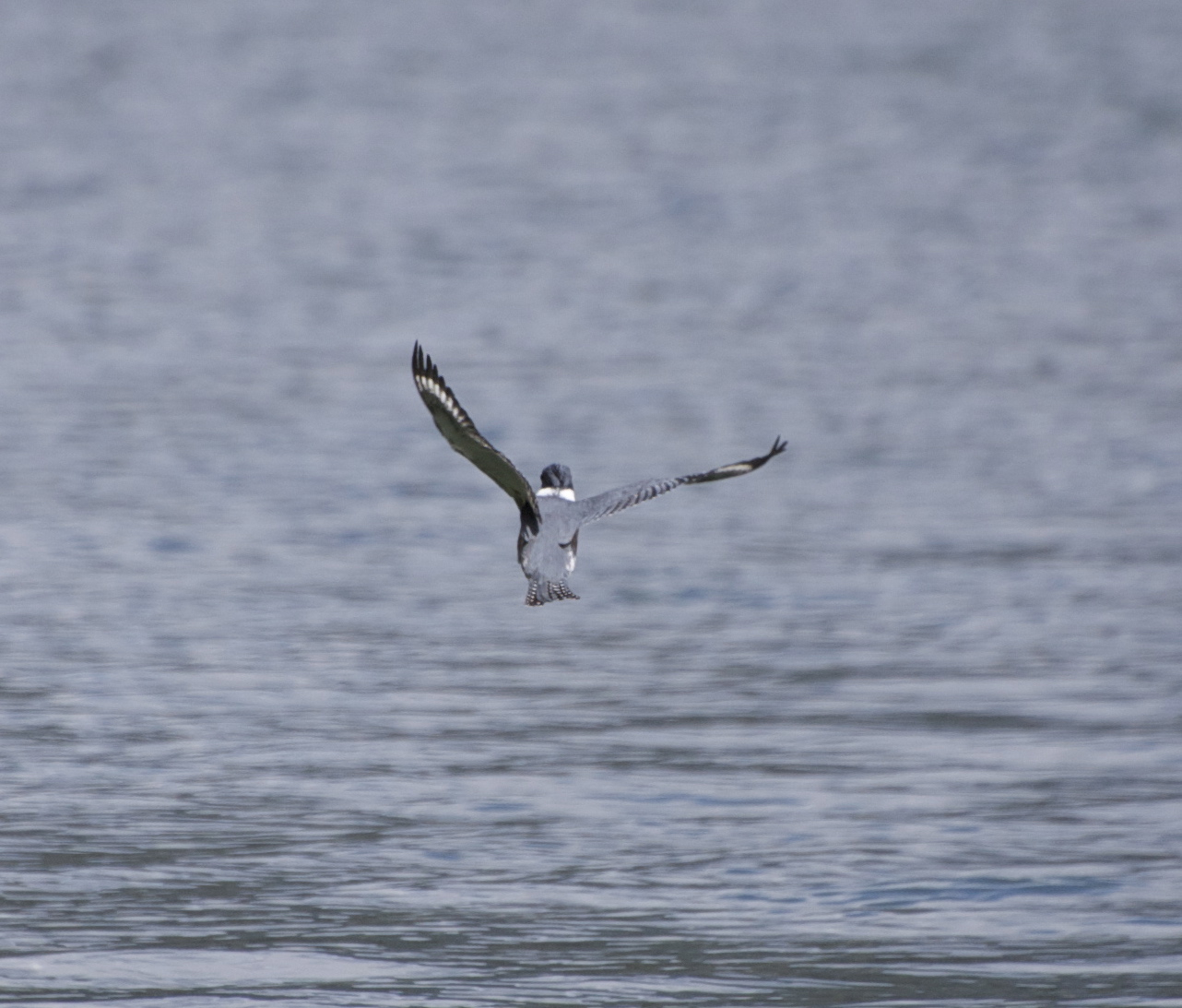
Last Sunday, while kids scrambled for eggs, others headed to Redwood Park, and birders ventured out across the county and beyond as a part of Godwit Days, Humboldt’s annual birding festival, along the west bank of the Mad River just up from the hatchery, a Belted Kingfisher struggled at the end of a long strand of fishing line. The line was entangled in overhanging branches and the bird, a female, presumably preparing with her partner for the season of rearing young, was suspended above the river, the line wrapped around the flight feathers of her left wing.

BEKI 22 April 14 - 02

A young man, Brian, had been walking along the bank – it was a warm, bright day – and saw her struggling. There was no one else around. He called Humboldt Wildlife Care Center. He offered to wait for our rescue team to arrive on scene to show us exactly her location.

It’s a terrible thing to see a bird snared in fishing line, struggling to get free, nowhere to stand. Serious injury seems certain and quite possibly life threatening. Brian saved this kingfisher’s life. If he hadn’t seen her or hadn’t called, a long, suffering death awaited her, all due to fishing line lost into the wild and forgotten.

BEKI 22 April 14 - 03During her exam, the kingfisher was clearly dehydrated, as her “squinty-eyes” attest.

We quickly placed a net below her to support her weight while we snipped the line. No apparent injuries were seen – the line wrapped her left wing’s primary feathers, but no bones were broken, nor was any skin. She was exhausted and dehydrated. She was still willing to fight. We brought her back to our clinic.

After a complete exam – she was in relatively good shape, a healthy bird, living well – we gave her a mild pain medication and anti-inflammatory drug, warmed fluids, and a safe, quiet place to rest.

BEKI 22 April 14 - 01Kingfishers’ 3rd and 4th toes are united. We call this kind of foot syndactyl.

Two years ago, when we were building our waterfowl aviary, we included a perch high above the pool. No duck or goose would ever use it, but we know that occasionally a kingfisher will come into care. Kingfishers in their home plunge-dive, like a tern, an osprey, or a Brown pelican, for their fish. Small, powerful birds with an extreme amount of panache, in captivity they can be difficult to feed. This aviary was about to get its test.

The next day in care we gavage-fed a liquid protein diet to continue her re-hydration. She was alert and attempting to fly so we moved her to the waterfowl aviary with the kingfisher perch. Over the course of that day she improved rapidly – not well enough to be released yet, but highly encouraging.

BEKI 22 April 14 - 04Our waterfowl aviary does double duty as Kingfisher housing.

The next morning she was sitting in the early sun, on the high perch above the pool that we’d stocked with small “feeder” fish. At her morning check she flew in circles around the aviary. She was fully restored. Her flight was perfect. She was a lucky bird.

Her release evaluation was quickly completed and the kingfisher was driven back up to Blue Lake and the river above the hatchery.

BEKI 22 April 14 - 06Belted Kingfisher, on her perch in the morning sun – feeling much better!

Fishing line kills thousands of animals along our coast each year. Our annual clean-up days do a lot to raise awareness and improve the environment, but much more is needed. Every time we go into the woods, to the beach, down the river, to the grocery store, we need to see what stupid thing has been lost or littered and pick it up. What if this beautiful and fit kingfisher had gotten tangled 3 weeks from now, and she hadn’t been seen. It could easily have gone that way, and somewhere it will. She would have died and somewhere nearby, her babies would have cried for her return that would never come. Earth Day is a fine thing, but really, Mother Earth needs us every day. Just as we need her.

+++++++++++++++++++++++++++++++++++++++++++

Your support makes our rescue and rehabilitation efforts possible. Please donate what you can. Every contribution helps us provide skilled and equipped care for native wildlife. Thank YOU!

Scroll down for more pictures and video of release.

BEKI 22 April 14 - 08Capture for release evaluation – not as easy as it looks…

BEKI 22 April 14 - 09The long path home, into the wild!

BEKI 22 April 14 - 10Arriving at the river’s bank…

BEKI 22 April 14 - 13A rare moment…

BEKI 22 April 14 - 18Happy wildlife caregivers celebrate Earth day every day!

BEKI 22 April 14 - 14Photos of birds flying away are the best!

BEKI 22 April 14 - 16Belted Kingfisher’s plea, “Don’t leave your killing debris in our river!”

Print
All photographs Laura Corsiglia/BAX.


Share

Wounded Western Grebes of 2014

When Western Grebes started coming in to Humboldt Wildlife Care Center in the middle of January, we were not sure what was causing their injuries. Large puncture wounds, crushed legs and wings… we surmised then and still have no better theory than conflicts with Sea lions when foraging. Over the course of the next few months, we admitted for care nearly 30 of these elegant and ferocious fish-eating birds.

Of these birds, however, only 2 were able to be fully rehabilitated and released. Most had injuries too severe to ever be able to heal well enough that they could thrive in the wild. This is without question one of the hardest parts of wildlife rehabilitation; – the repeated exposure to devastating injury.

Because aquatic birds need to be on water while in care this can make treating wounds below their waterline difficult. Only recent advances in aquatic bird wound management have allowed for more of these birds to survive their injuries and be returned to their lives. In the past it was assumed that the weeks required for deep, penetrating wounds to heal meant that birds who need to be on water were not good candidates for rehabilitation. Many birds with such wounds were euthanized for humane reasons.

With time and trial and error, rehabilitators have learned techniques that mitigate some of the negative outcomes of being kept off water as well as ways to successfully treat these wounds while the bird is housed on water. This requires skilled staff and purpose-built infrastructure.

So, while the number is low, two of the birds we treated recovered from their deep wounds and were recently released back to their free and wild lives. Thanks to your support we were able to provide the extensive, specialized care these birds require.

WEGR NB & P95 release 8 April 14  - 001Release evaluation includes a complete physical examination. The lobed feet of grebes defines their species.


WEGR NB & P95 release 8 April 14  - 003The freshly healed puncture wound with new feather growth.


WEGR NB & P95 release 8 April 14  - 007

WEGR NB & P95 release 8 April 14  - 013Out of the box and into the sea!
WEGR NB & P95 release 8 April 14  - 019Another happy wildlife rehabilitator!

WEGR NB & P95 release 8 April 14  - 021Off to resume a life interrupted!

WEGR NB & P95 release 8 April 14  - 025And making new friends…
WEGR NB & P95 release 8 April 14  - 057Evaluating feather condition

WEGR NB & P95 release 8 April 14  - 059A very small amount of blood can tell us a great deal about the patient’s health.

WEGR NB & P95 release 8 April 14  - 071And away…

WEGR NB & P95 release 8 April 14  - 073

WEGR NB & P95 release 8 April 14  - 089

WEGR NB & P95 release 8 April 14  - 111At this release site, many grebes are already there…

Share

What am I in for? Well, let me tell you….

This Western Gull, entangled in fishing line and hooks at Trinidad Pier, was recently in our care (photos and story soon to come). You can help Bird Ally X/Humboldt Wildlife Care Center rescue and provide the necessary care for wild animals, like this gull, who encounter the modern world at its worst.

mar-april jar
No one wants a fish hook for dinner.

Please contribute. Thank you for being a part of this life-saving work!

Share