
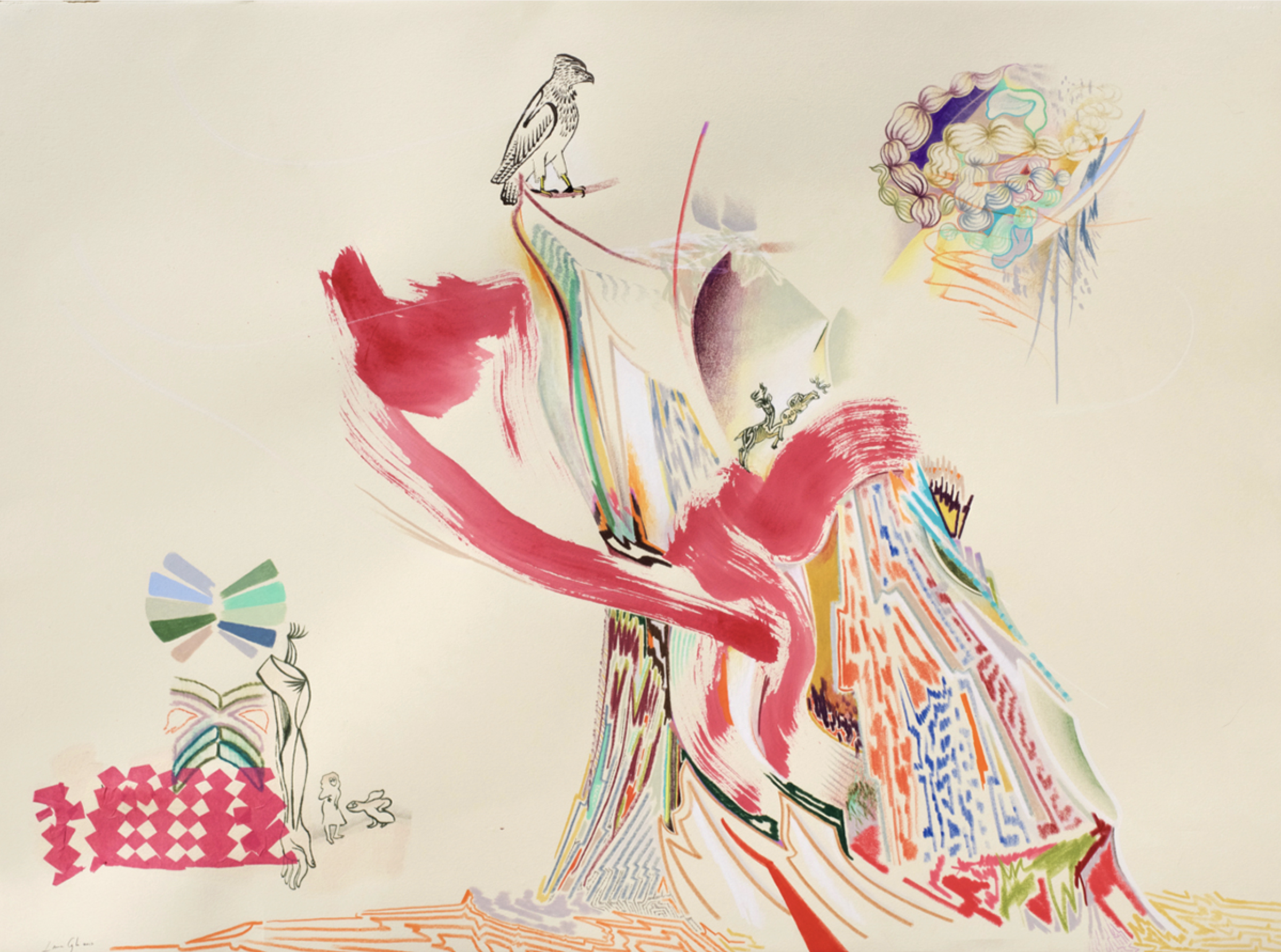
featured image: Nesting Materials: They don’t die 22″ x 30″ ink, pencil, color pencil, china marker, collage on paper 2017, which was lost in the fire.
It was 2004 when Laura Corsiglia named me the Bird Ally. I had been working in Southern California, in Los Angeles and in Trona, as a wildlife rehabilitator, focused on aquatic birds. I worked in a seabird hospital in L.A., as well as a toxic waste site in Trona, where freshwater birds – Green winged teals, White pelicans, Pied-billed grebes, Common loons – would land on toxic tailing ponds deep in the desert and never leave again. The work drove me to the poorhouse, you could say. One day on my way out to Trona, at a gas stop in Acton near midnight, my belongings were stolen from my truck, – a computer with thousands of photographs of victims and conditions of the site in Trona, my binoculars and journals. The loss was more than I could sustain on my very low salary and after two months I was forced to move back to Seattle, where my friends were and where I could live more cheaply while sorting out next steps.
My first night back in Seattle, I went to the theater. Kaleb Kerr, an old friend in the city, had a regular show, a satirical staged game show, Big Wheel Bingo, that he performed weekly at the The Jewel Box Theater. After the show that night, he had a late meeting for a film project, working title, Cross-pollination.
I tagged along with Kaleb to the film project meeting. He told me it was a dance/art film with the Performance Art Network (PAN) – butoh dance, improvised music and masks. We arrived at one of the old commercial buildings in Pioneer Square, a building known as the US Rubber building alternatively as Luscious Studios. A couple of years earlier I had dived through a flaming hoop inside this building while goofing off with some demented circus performers. We went upstairs to the meeting and there she was, Laura. Fortunately, since I’m at my best when napping, I was overcome with exhaustion from my road trip and promptly fell asleep on an empty spot of floor.
I knew Laura Corsiglia by reputation before I met her. As an artist and the intrepid partner of the poet Ted Joans, she was famous among my circle of friends. While many of my pals knew her, I had never met her, other than seeing her at readings that Ted gave in Seattle. The closest I came to talking with her was in April 2002, when she and Ted came down to Seattle from Vancouver, BC to a luncheon meeting that had been organized so that I could meet Ted. Over twenty people came to the cafe (dear old Zeitgeist) and while I sat next to Ted and enjoyed conversation with him, Laura took the far end of the table and held court for the overflow crowd. It sounds kind of like a scene from a celebrity event, but among the bohemian weirdos of Seattle who surrounded me, it was. That meeting had been arranged right before I left Seattle to take the desert job in Trona, pulling sick and dying birds from toxic tailing ponds. I had said goodbye to my damp and mild Pacific Northwest and loaded a few things in my truck and drove to the Mojave.
Two years later in March of 2004, Laura had been a widow for a year. Ted Joans had died April 25, 2003, which I had learned about while living my desert solitaire life. The afternoon of my first day back in Seattle, I was having coffee with my pal, Stefanie, when she said to me, “You know, Laura Corsiglia is in town right now.” Frankly I didn’t know what to make of that. But let’s just say Stefanie knew, or felt, something that I did not.
Working for the previous two years at a toxic site in the valley west of Death Valley, Searles Valley. Overall a borax mine, the enormous spread an easy 30 square miles, the valley was covered in a salt crust broken up by tailing ponds, some a couple square miles themselves. Initially brought there to monitor a breeding band of threatened Western Snowy Plover, soon I was also working on the main project, rescuing and rehabilitating the aquatic birds who were attracted to desert ponds, unaware that they were hyper-saline and toxic. Also, I searched for the dead bodies of birds, teals, loons, grebes, mallards, white pelicans, so that the mining company would have to account for the “illegal take.” The company paid a fine for every dead bird. They did not enjoy my presence.
To get on to the site in my little truck, an ’81 Toyota, I needed to have the name of the organization I represented, International Bird Rescue Research Center, on the side of my vehicle. My supervisor provided me a small magnetic sign for my truck door that read “BIRD RESCUE.” April 2002 I stuck it on my truck and left it. It was still there two years later.
A few days after that meeting at Luscious, I went with Kaleb for a day of shooting for the film that was being done at the empty, dilapidated old Rainier Brewery, right there just a few feet from crowded I-5. Up until ten days before this, I had been working 50-60 hours a week for the previous 4 years, so I was ready and fit for some hard labor. For one scene there was to be a cascade of water over one of the dancers, so I volunteered to haul several full 5 gallon buckets up a few flights of iron and concrete stairs to be in position to pour them over the head of an intense dancer, Alan Sutherland, who was in the role of the Shark. The cast and crew snacked from the copious spread of Costco croissants and muffins. I made coffee for all. I watched Laura work, adjusting masks that she had made from cardboard and string, and costumes sewn from sheets of greenhouse plastic. A madman with multiple digital cameras was directing the action.
It was March and the weather was damp, dark and chilly. I got blankets for dancers between scenes. And slowly, as I helped her where I could while she adjusted the costumes and masks she’d made, arranged scenes, discussed actions, Laura and I began to talk about the ideas being explored in the film and also about her strange trajectory toward this project. In many ways this was our courtship even though neither of us knew that at the time.
And so it began. Laura and I started chatting about what it meant to be alive on earth; – to dream – to build a nest – to build a scene – to build things that help you see things that help you be things. One thing we noticed – that I noticed – is that Laura and I didn’t need to explain our perceptions of wildness and what it means to live in that wildness unaware of any real boundary to it. We knew that every bear, every bird, every salmon, every fir, looked at a world that is also our world – that the sum of our world was made from each incarnate view. Talking together was a blast at the moment we started.
Laura had recently won an award from the City of Seattle, for a painting, Deer Dust, that would be shown soon at a City gallery, and enter its permanent collection. She had written a long text that shares its title in 2002. She sent me a hard copy, as we were all saying in those days. I was publishing a small poetry ‘zine at that time, with dreams of going bigger, called the fulcrum – which had at the middle of each issue a featured artist or writer. I pleaded with her to let me publish it in the upcoming issue, and to my surprise she said yes!
(you can read Deer Dust here at the digital remains of the fulcrum, there are no remaining copies available of fulcrum 5)
Soon a task Laura needed help with sealed, as we say, the deal. She’d sold a painting, Hummingbird Ojos Fertiles, to a collector in Texas. She needed to ship the painting, and as it happened the painting was then stored in Vancouver, BC, about 140 miles north. I offered to drive her up in my little truck.
I loved taking road trips with new friends and old. The cab of my truck was already my interview capsule, where I’d spent many lovely hours hearing about the strange and beautiful ideas of my friends. I was eager to enjoy some hours on the highway with Laura, seeing the sights and shooting the breeze.
We had entered a world of multiple converging vectors – which does happen from time to time – things all just seem to fall into place – you meet the right people, the sunlight lands just so, a fresh breeze blows and the phone rings with news you hadn’t realized you’d been waiting for but you had – and one of the proofs occurred the first time that we ran errands together for Cross-pollination. Laura was surprised to see that my truck was my truck because she had already seen and photographed it due to the BIRD RESCUE magnetic sign. She had seen it parked on the street without knowing it was mine and taken its picture.
In any case, by the time we were riding together up I-5 to Vancouver, we had more proof than that that our meeting was provident.
Northbound in the small cab, I asked questions and she told me stories of her life from early childhood up to the the day before we met.
Laura was born in Vancouver, British Columbia, Canada and raised in a small First Nations village on the Nass River in Northern BC. Her father was born and raised in New Jersey, went to school in Texas before leaving for Canada at a certain point to avoid the horrors of Viet Nam. Laura’s mother had come to North America from France to study English at Cornell, earning her doctorate and becoming a linguist who specialized in the Native languages of the Northwest Coast. Laura was raised bilingually at home, learning and speaking french with her mother and english with her father, while living in a First Nations village, New Aiyansh, and going to grade school there, as well as traveling back and forth to France with her mother from the time she was three.
At 5, she tells me, she knew she was artist and told her parents so. They didn’t dispute it. She’s worked continuously since, without ceasing. From the Nass Valley, Laura moved to Victoria, on Vancouver Island where she attended high school. Her mother relocated to Halifax, Nova Scotia for a teaching position at a private university there. Laura spent her junior year in Paris going to french high school. After attending her last year of high school in Victoria, Laura returned to France for school, living with a close aunt and attending the legendary Beaux-Arts de Paris.
It was in Paris, at the iconic bookshop Shakespeare and Co., that Laura met Ted Joans, jazz poet, artist, musician, traveler, and maybe above all else, a living Surrealist who lived a precarious but adventurous “poemlife.”
“Jazz is my religion, and Surrealism is my point of view,” Ted has famously said.
Soon Laura and Ted became a pair. she told me she’d finish a painting and he would say to her, “Beauful! Museum quality! Now put it away and make another,” like a veteran showing an up and comer what to do with her new trumpet. Ted was a lover and a mentor.
Between her childhood experiences, her schooling and her relationship with Ted, who in turn introduced her to a brilliant international community of writers and artists, Laura’s life as a young artist was deeply supported and richly informed.
Laura and Ted began their poemlife together in Paris November 1991 and they lived it until April 2003 in Vancouver, when Ted died. They spent the 90s in Paris, Seattle and Vancouver, with long stays in Africa, New York City, Oaxaca, and traveling from reading to reading, and meeting with surrealists and other artists the world over. In every location, whether on a river to Timbuktu, or a cafe in Oaxaca, or studio at the Beaux-Arts, Laura worked. She filled paper, canvasses, notebooks while traveling, her themes of the marvelous, and the wild animals of home populated her work from the start.
When Laura and I met, she was far from rich, far from famous in the “straight world.” Among bohemians, international poets, surrealists, writers, and collectors, however, Laura was at the center of a thriving global community. And her body of work was large, as I would more materially learn.
In Vancouver, we collected the painting and spent the night at her lifelong friend, Alannah’s house. We ate with all the housemates, well-read and witty Canadians all, and I slept on the couch in the living room.
Southbound to Seattle, we stopped off at exit 218 of I-5, Starbird Rd because of its name. A small rural road, it led to a marshy area among a stand of Alder and young Douglas firs. We listened to a chorus of frogs and stood there in the early evening of early Spring. It did seem like something was happening, but who knew what.
As we made it back to Seattle, Laura suggested a role for me in the film which she called the Bird Ally. It wasn’t as far-fetched an idea as it seems, me in the project as a performer – as a young adult I had studied ballet and other forms and had choreographed a community musical theater production. Although a couple decades had passed since my dancing days, I was basically still a theater kid at heart. And in the wake of of the previous two years of work I’d just done in the desert it was a good way for me to process all that I had been through, – in dance, in music and on screen, even if the screen was only a computer.
As I mentioned, Cross-pollination was a collaboration between a butoh-inspired dance collective, the Performance Art Network, and Laura. Originally the project was conceived as a one-time performance with the dancers using masks and costumes made by Laura to be performed at the Bellevue Art Museum in the Seattle area. Right before the evening of the performance, the museum’s board expressed alarm that the programming being produced was too avant-garde for them and their community and without warning closed the museum doors, to reopen much later with a focus less on art, more on craft. So you know.
As it turned out, I had returned to Seattle just days after the cancellation of the performance, when the dance corps and Laura had begun realizing the project anew as film.
Working on Cross-pollination had been one of the means by which Laura experienced and processed her grief after Ted’s death, and, as it turns out, led her from a deeply imagined and ritualized and dreamed relationship to the Wild to something that included holding orphaned ducklings in her hands.
We worked on this project for over a year, and we fell in love, and we moved in together into a warehouse loft in Seattle and she painted and I wrote and produced a poetry and performance show every Thursday in our space (which Laura and our roommates generously tolerated) called the Perfect Room and responded to oil spills when called.
After nearly two years, the building was lost to development and we left Seattle together for an island in the Salish Sea.
Right at that time, Laura and a small number of the dancers took Cross-pollination as a stage show to Korea for a mime festival – they won first prize, then they toured the show in Japan. When Laura returned to our new island home, a 50 year old small trailer in the middle of a pasture overlooking Lummi Bay, we decided to get married. And we did, on the beach of the Strait of Juan de Fuca, under ancient Doug firs, in East Sooke on Vancouver Island, on Sooke land, not far by boat, but hours by car and ferry from our shack on Lummi Island.
About 3 years after our wedding the idea came up for Bird Ally X. We were in California and had been for a year. I had been called to an oil spill. A container ship, the Cosco Busan had collided with the Bay Bridge in San Francisco Bay leaking tens of thousands of gallons of its fuel, so-called bunker fuel, a sludgy thick petroleum product, at the worst possible time, just after the diverse array of aquatic birds who winter in the mild coastal climate had arrived. We treated about 1500 impacted Grebes, Seaducks and Murres.
A two week stint at the facility (IBR) in Fairfield had turned into a two month stint and long after the spill response had ended we looked up and it was 2009.
Laura worked continuously during this period, making paintings and drawings as big as whatever housing we had arranged could accommodate. For a couple of year we lived in 27 foot long 1972 Winnebago Chieftain parked on the property of IBR. I put a piece of plywood across the living room/master bedroom at the rear of the vehicle with a big back window facing the Suisun Marsh and Mount Diablo. Laura produced hundreds of drawings there. In California she also began helping with wildlife work – beginning, as we all do, it seems, with baby Mallards, eventually becoming a masterful rinser in the feather cleaning process of oil spill victims.
It was in Fairfield that I told Laura I had been dreaming of an organization of Bird Allies, borrowing her character’s name, who would be Zorro like defenders of the wild, who could zoom in discreetly, take care of whatever was the issue – deer fencing that kept catching small owls, open grease traps at restaurants that were a threat to pigeons, and the like and more. We could leave an X as proof that we had been there. I wanted to call us Bird Ally X, a team of clandestine highly skilled forces for good. It’s true that I had been studying the speeches and transcripts of Malcolm X for most of the period of Bush II, and was deeply fond of his moral intelligence and intense courage, obvious by his actions but which the beauty of his prose also revealed. So any homage to him was pure delight.
In some ways we could say that the rest is history and be right. The first Bird Ally X blog was created in April 2009. Several months later, some events transpired shall we say, that suddenly left some treasured and incredible colleagues available to such a plan, and Laura and I sprang the idea on the other soon to be co-founders. By May 2010 we had our nonprofit status, something that Laura and I had worked on diligently through the winter, filling out forms, writing by-laws and such.
At the end of 2009, late November, Laura and I had moved to Arcata, still in our ancient Winnebago and she still working in the makeshift studio in the RV’s back room, parked at the Sandpiper on South G.
Our move to Arcata was not a professional decision, but personal. My daughter and her husband were checking out the area and considering relocating here from New Jersey, my old country. After a few months at the Sandpiper, we sold the Winnebago when an apartment in Manila opened up. We moved in April 1, 2010.
I had gone back to being primarily a spill responder while we considered how best to implement our BAX vision.
In the summer of 2010 Laura and I both went to Michigan for several months to respond to a pipeline breach that spilled millions of gallons of tar sands oil into the Kalamazoo River. Laura and I ended up leading the wildlife response for the winter months, when the wildlife rescue component of the response was frozen out by Michigan winter – inside however we had over 500 aquatic turtles who couldn’t be released because they hadn’t made it to the river in time, it was supposed, to survive the winter by hibernating.
So Laura and I with a motley crew of awesome laborers turned care-providers gave those turtles an endless indoor summer. And in our hotel room at the nearby Holiday Inn, Laura had a drawing table set up and she worked. While we were in Michigan, Laura had a show in Arcata at the Upstairs Gallery. She flew back for a couple days to set it up and to be there for the opening and then flew back to the spill, already in progress.
We were in Michigan through the end of the year into 2011. My daughter and her husband had decided to move to Asheville, North Carolina with their second child on the way. Without a solid reason to stay in Arcata, we took walks in the dunes and dune forest and considered where we should be to maximize the potential for BAX. We had some freedom because we had both worked the oil spill for 6 months which filled our coffers much fuller than usual. We upgraded our gear. We fixed our truck. Laura worked in our apartment, making drawings and paintings.
In August of 2011, I got an email from a colleague in spill response. His partner, a pelican biologist, had seen some wet juvenile Brown Pelicans in Crescent City as well as Shelter Cove, and their were rumors of a Pelican die-off. the email came the evening that we had just returned from a cross-country road trip to be in Asheville for my next grandchild’s birth. The following morning we loaded up our spotting scope and dressed warmly, because it was a cold August and we’d just been in the midwest and desert, and we drove to Crescent City and worked our way south. We found many soggy, obviously contaminated Pelicans. They appeared to be contaminated with fish waste, and sure enough we saw getting into dumpsters near fish cleaning tables in all the harbors from Crescent City to Shelter Cove.
With January Bill, who is one of the co-founders of Bird Ally X, and who also had relocated to Humboldt County, we checked in with Humboldt Wildlife Care Center (HWCC) to see if we could use their facility to launch the rescue effort. Their board of directors was concerned about the cost. We assured them that we would handle the fundraising and leave them in better shape than they currently were. Direct action providing care for wild animals in need was only part of our mission statement. Supporting small organizations without the resources or experience to handle influxes of patients from a small or large disaster was and still is another important component of our mission.
We treated about 55 young Brown pelicans in August and September of 2011 at HWCC. We built pools and aquatic bird housing to meet the needs of the response. Between what was left of our spill pay from the previous winter and the generous support from the community, HWCC was in better shape than before the response, with an improved facility and an increased capacity. I stayed on, coming to HWCC every day to operate these new features which are demanding and potentially unsafe in less experienced hands.
In 2010, when we were still pondering where to establish ourselves after the Winnebago days, Laura, January and I had visited with the HWCC board, introducing ourselves, offering our assistance. Our offer was politely declined. I joked to Laura afterwards that it was for the best. That HWCC would be a “black hole of need” – well, a year later and here we were. Such are the twists of destiny that after landing in Arcata, Laura stayed.
While I worked at HWCC and along with the other BAX co-founders worked on our first book, Introduction to Aquatic Bird Rehabilitation, Laura also worked on the administrative tasks of merging HWCC and BAX as the boards of both organizations decided to do. And of course, Laura, who works all day, most every day, drew and painted.
We established a work space for her in our Manila pad. She continued to show work locally and around the world, maintaining her relationships with the international surrealist community. Eventually we got our things out of storage, including most of her work from before we came to California at the end of 2007. Her Paris days, her travel journals from the many countries in Africa that she visited with Ted, her Seattle warehouse paintings, grown large because of the abundant space we shared that had been rolled up in a storage unit in Bellingham, her oil paintings from the early 90s, all of the drawings small and very large done in Seattle and then during our time on the island in the Salish Sea – Laura’s work from then had been in a storage unit in Bellingham, Washington from 2008 to 2014 when we finally had the funds to go get it all in a U-Haul to be reunited in Arcata.
Our small apartment in the tsunami zone filled with irreplaceable and priceless treasure.
Eventually, in 2019, Laura was able to get a studio in the Stewart Building in Arcata. It served her very well as a place to work as well as store her thousands drawings and paintings. Moving her archive out of Manila was relieving. Ted’s archive, which Laura has fiercely protected for the last 23 years, is still in Manila.
When Cal Poly Humboldt purchased and took over the Stewart Building, the artists with studios had to scatter. Cutting it down to the wire before they had to vacate, Laura found the storefront 829 10th St about a block off the plaza in Arcata. It had so much potential as a studio, and it was big enough to share the space and costs. Laura rented it in August 2025. By September, she and three colleagues were making art there. The storefront had enough space that art storage, always an issue, was resolved. The artists brought their lives’ work to the studio. Laura moved her studio from Stewart to 10th Street, a short move down the hill. She had to hire help there was so much work to move. Another of the artists, who also stored much irreplaceable work in the studio, arranged for the four of them to have a show together at the Morris Graves Museum in Eureka, around the bay. Laura and I discussed moving Ted’s archive to 10th St. We talked about moving her drawing table and handful of drawings stored in our apartment to 10 St. too. It seemed good to get everything out of the tsunami zone. End of year non-profit tasks took precedence and we didn’t get any of these things done. And then, the day after New Year’s, chaos tore its way through whatever hole or weak spot it finds and a fire ignited somewhere in the city half-block where 839 10th St stood. In 3 hours it was rubble.
We were working at home, Laura and I, when a friend texted that there was a fire in Arcata that might involve the studio. We raced to town. The fire could be seen across the bottoms from Manila. Please let this tragedy be someone else’s is most likely a common enough prayer. It was certainly mine to the extent that I pray. Of course, the fire was our tragedy too. The fire was Laura’s tragedy. I held her as we watched her studio and her life’s work turn to ash on 10th St in Arcata California, 280 miles from San Francisco, 700 miles from British Columbia, 3000 miles from New York City, and 5500 miles from Paris.
There’s a theological term that those who care about such matters use as a sort of defense against the why something as important as the Coming of the Lord, set in Bethlehem on the outer fringes of the Roman Empire – the term or phrase, I learned, I believe, from Annie Dillard is the Scandal of Particularity. It’s a ridiculous question: why here? why now? All things when they occur are here and now. I watched emergency responders work, I watched the dark smoke roll across the nearby buildings like a rearing dragon. I watched the Western-facade of 829 collapse on to 10th street. I watched apartments above the stores burn. I watched a beloved bookstore burn. I watched the thousands of messages that Laura has retrieved from the realm that must be called the marvelous, the marvelous as known by the first Surrealists, known by every wild thing under the Sun, the marvelous that Laura can visit, see, engage and return with gifts from there for here – for us here – I watched them become smoke. And I asked why here? why now? as I did.
I’m lucky. I’ve had an excellent perch from which to watch Laura make her works since 2004. I’ve learned how to be a good studio cat, companionable but not intrusive, too much. I can listen to marks as her pencil slams into the paper and her groan or grunt when she’s pushes something heavy up from the depths, and the soft sound of her breathing as small things tug her gently this way and that. Laura says, and she means this in real terms that ”drawings are alive.”
This is another point in which we had instant agreement. The world is more navigable, in some ways, if you take it as it comes, as it enters your eye, as it conveys itself into your skin, your ears. The sidelong glance that reveals other realms with their own units of measure, which still – no matter how strange – also contain you, and you them.
I know that two cats were lost in the blaze. I am sure that some plants must have been burned alive as well. The suffering that day was sufficient – we had more than our fill. Yet still there was more – a few days later federal goons murdered a woman in the street and then tried to say it was her own damn fault. The losses mount daily, locally and non-locally and spooky action at a distance is looking more and more like the defense of choice. I feel spiritually besieged by events near and far, that evil thinks now is the right time to attack. I do not know if Laura shares this sense because until she reads this we won’t have discussed it. The fire reeks of disorder, distinct from the random or chaotic, order with malicious intent – a toying with chaos and hiding in its lack of pattern, like be-dazzled battleships fighting for tyranny.
The center of Arcata has a deep gash, a terrible wound. It’s hard to see it. I went to look the second morning after the blaze. The area where 829 had stood had the least amount of debris, of course, I realized, because it was an empty box filled with paper. All gone. A smoke detector somewhere deep in the mess where the Ace Housewares store had been was still sounding its alarm. Laura has not been to the site since the day before the fire, when we saw Marty Supreme on New Year’s Day at the Minor across the street. It’s going to be strange to have the streets of our little village always and forever be the scene where so much was lost. There are a lot of wounds born individually inside that large wound. But none are smaller than the total. Each of those cats lost everything they had to lose.
I wrote this because I know the literal weight and I have a pretty good estimate for the less tangible weight of what Laura and the world lost when the fire took her work. I wrote this because I want to make certain it’s known that what Laura gives when she steps away from her work to help care for the clinic, or help reunite a baby hummingbird with their parents is identical to what she gives her work. I want to help others understand what was lost because that work mattered and it left this world too soon, unable to complete its destiny, even though its absence makes its presence hard to show.
Laura is an astonishment whose hands are antennae that she arranges just so, gathering the signals she receives that with her hands she turns to image and arranges them also just so. For 25 years I’ve been saying to all the youngsters I meet that warrior-nurses are what the future needs most and I am telling you that Laura is as fine a warrior-nurse as the world has ever seen.
Two days after the fire, a Sunday, only Michael’s was open which might have paper and pencils. That evening Laura was back to work, at her makeshift drawing table between our kitchen and our record player. Some paper she had ordered before the fire arrived a couple of days later. Donated materials from the community of artists in Humboldt County began to arrive.
Laura is currently working on large pieces of black paper using pencils and pastels and ink… she has completed 35 of them, and she’s at work right now. She is calling the series Aftermath – it’s an old word, 500 years old, meaning the first growth after a field has been mowed or burned.

ps – The support from both the community of artists here and around the world and our neighbors across Humboldt, for Laura yes, but for her studio-mates and for all of the others deeply hurt by this fire has been buoying, inspiring, materially helpful and in many case simply downright fun at a time when fun is hard to come by. My appreciation for the support all have given is too deep to say without blotting tears out of my keyboard. Happenstance brought us to Humboldt , the community we found here, and the work we can do here made it home.
