
Burlington Campground of the Humboldt Redwood State Parks is just south of Weott, along the Avenue of the Giants, about 50 miles south of our facility on Humboldt Bay. It was in the parking lot of Burlington Campground that first one newly flighted Allen’s Hummingbird (Selasphorus sasin, one of the hummingbird species native to the Redwood coast) got into trouble and then soon after so did their twin. Who knows what happened? Maybe they flew too far from their nest site and were lost to their parents. Maybe their parents had done all they could but their condition was too poor for their efforts to save them. In any case first one and then the other had run out of options. They were forced to use human hands to get the help they needed to survive.
The call came in about 10 o’clock in the morning just after our daily morning meeting. A person had picked up a mite-covered hummingbird from under a parked car in the parking lot of Burlington Campground. We don’t know exactly what a hummingbird has to do to make a person stop and see them under a car. But this youngster did it. And soon their sibling was found on the other side of the lot, and in the same condition.
We sent one of our clinic staff down to the campground. The region we serve is enormous! Between Del Norte, Trinity, western Siskiyou and northern Mendocino counties we cover an area the size of New Jersey. So, fifty miles down US 101 is a pretty ordinary trek.
Once at our clinic we gave each tiny bird (3.1 and 3.4 grams!) a thorough exam. Both were capable of flight but lacked the energy. We offered them long sips of the special nectar we prepare that provides a balanced diet for young hummingbirds. We gave them medications to control the feather mites that plagued them. (always especially grateful to hit the shower after dealing with feather parasites!!)
Parasites are usually a pretty good problem to have, mainly because it’s an easy one to solve. Just take the medicine that kills that parasite and boom! – your energy is your own again.
The one who was lighter by three-tenths of a gram was also more lethargic. The bigger bird was enthusiastic about being fed while the weaker had to be encouraged to eat – still it took two days for them to recover sufficiently to be able to thermoregulate, that is maintain a normal temperature, without our help.
A hummingbird, if you haven’t noticed, is a very small bird. As mentioned these guys weigh about three grams. I weigh about seventy thousand grams. The power imbalance is terrifying. They make me feel like a giant clod of mud, a dumb rock ready to roll down the mountain and crush the town. After four days in care, with nectar in a feeder and fresh flowers arranged throughout their aviary, we stopped handling them and allowed them a couple days of recovery without being bothered or, frankly, endangered by our looming gargantuan selves.
After two days of “self-care”, it was time to drive them home.
Hey, you have to live and work somewhere and we have it pretty good. The Avenue of the Giants is takes you into one of the world’s splendors. It’s a great office we have here.
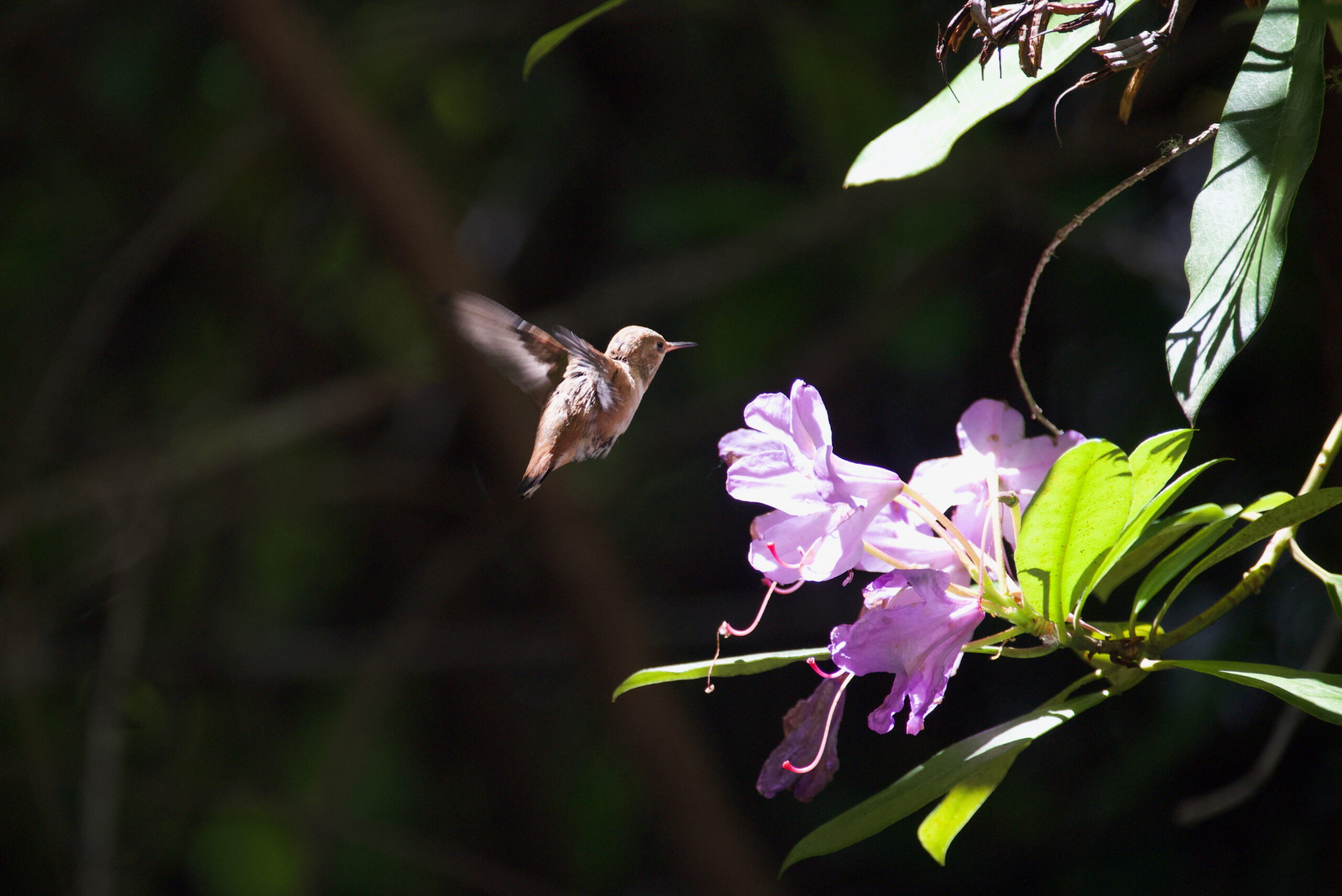
We were short-staffed that day but when our chief photographer, co-founder, expert baby bird reuniter and BAX art director, Laura Corsiglia arrived at the release site needing to open the box and close the shutter over and over again, park staff enthusiastically joined in to help release the young birds – they knew the exact giant Rhododendron that hummingbirds frequent. Check out the pics.


Your support makes our work possible. Thank you for ensuring that our wild neighbors in need have some human hands at their disposal. It means the world to all of us.

photos: Laura Corsiglia
