
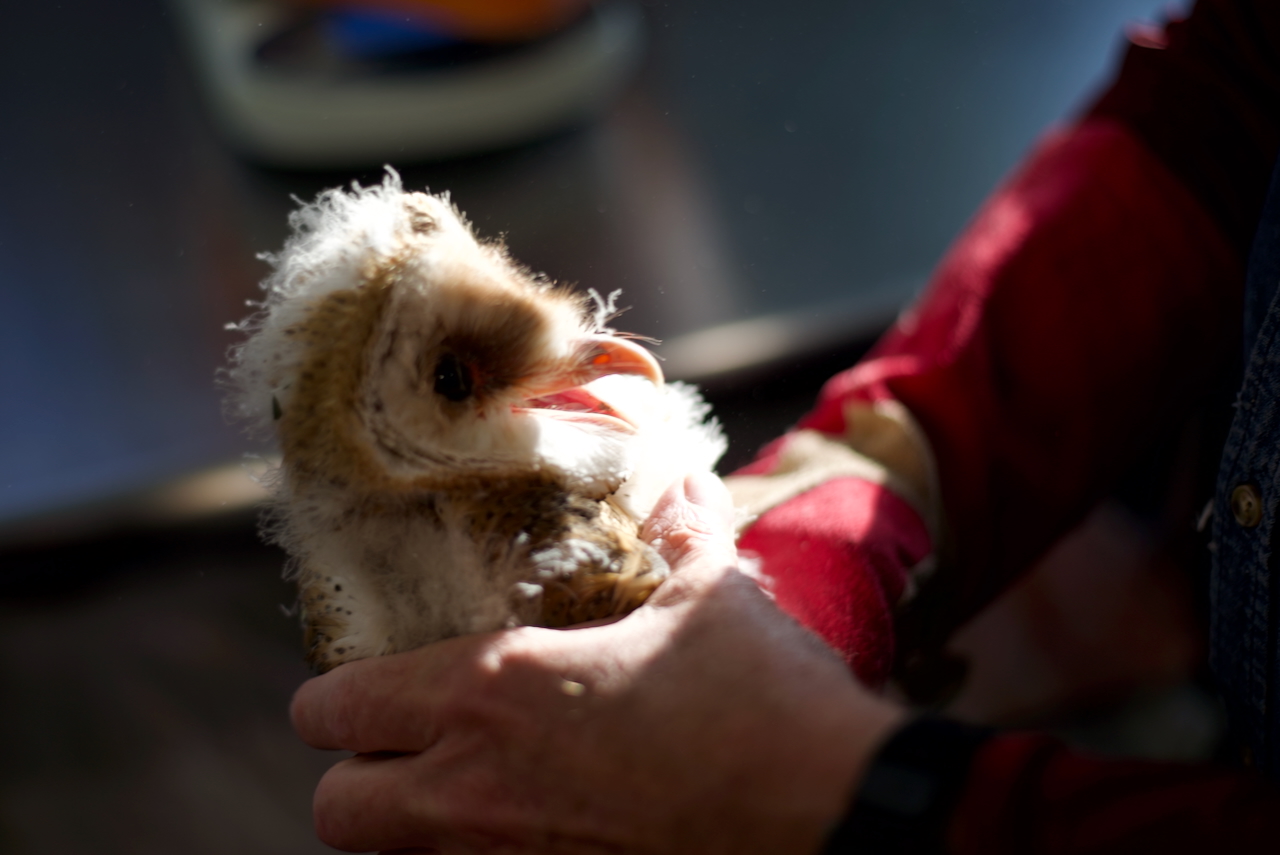
Over the last few Summers, American Barn Owl (Tyto furcata) babies have become common patients at Humboldt Wildlife Care Center. In 2022 we admitted six who had been nesting babies in bales of hay near Yreka when those bales were sold to someone in Ferndale. An amazing and nearly catastrophic journey, but we got them and they were the last owl babies to be raised in our raptor aviary in Bayside, before we moved. Every year since we’ve treated 2-6 Barn Owl chicks during the baby season.
We’re not sure why the recent surge in babies – we’ve treated more in the last 5 Summers than we did in the preceding ten – but there it is. For my part, when I began my career in wildlife rehabilitation in the Seattle area over 25 years ago (at my dear alma mater, PAWS) we routinely treated ten or more babies each year. So in some ways this uptick is a return to the past for me.
Random occurrences, such as the hay bales you’ve built a nest in going mobile, are unpredictable – or perhaps stochastic is the better way to say it – in any case, it’s a tough break, yet not as concerning as nest failures due to rat poison, say.
So far in the Summer of 2026 we’ve treated 4 baby Barn Owls. The first two we admitted in late May. They were released mid-July. Those babies had been found in Loleta, off Hookton Road. They appeared to have fallen from their nest. In fairly good condition they quickly began picking up pieces of thawed rat. They were angry at* us the entire time in care, hissing as they do whenever they were up for weight checks and routine exams. (You can search baby Barn Owl hissing and you will find all sorts of videos that will make you mad. Best way to hear baby Barn Owls hiss? Volunteer at your local wildlife center in the Summer.)


you’re a butterfly, and butterflies are free to fly
fly away, high away, bye-bye …” (Bernie Taupin/Elton John)
This also applies to Barn Owls.
The next two were also siblings, and also from a local spot. Up in the grid-work under the Hammond Bridge on the Hammond Trail, two babies had fallen from an active Barn Owl nest onto a steel girder below.
Upon admission they had suffered a few minor abrasions and were mildly dehydrated – like the kind of dehydrated you’d feel after a good run on the beach looking for a bird, – pretty darn thirsty, but treatable without an IV drip. The other two Barn owls were still in care, but in the aviary, already flying and eating live prey. This was the end of June and they were about the age the first two owls were when they had been admitted. Nestlings, big white balls of fluff with insanely adept feet and talons with which to make you dead and sorry you even looked at them.
Many thawed rats later … Each of them by mid-August had graduated to the big aviary. In other words, they’d fledged. It took these two owls nearly three weeks to realize that the live rats in the aviary were for them to hunt and eat. Obviously, we cannot release baby predators if they aren’t able to provide for themselves in wild freedom.
Eventually they did discover the joys of sustenance and a fresher dinner. They were released the second week of September in the Arcata bottoms, near the bridge where they entered the world.


By mid-September, usually, we feel we can characterize how the busy Season went confidently. I started writing this piece convinced that we were done with baby Barn Owls. And then this happened.

A bale of hay sold to a rancher in Rio Dell had three baby Barn Owls nestled inside. The hay had been in the county for two months according to the people who found them, which if true, would mean these owls were locally sourced. Close to fledging, with most of their juvenile feathers poking through the down, these guys nearly doubled our baby Barn Owl caseload for the year!
Now after two weeks in care, they have not yet fledged but they are doing well, housed out doors in a small aviary eating well, gaining weight, and beginning to develop a taste for liveys.


So we have more owl babies in care! That’s why we’re here. We all hatch helplessly into this world. Sometimes it goes badly before we’ve even stretched our wings. This is where our work begins and this is why you support our mission: together we are giving these beautifully mysterious beings a second chance to fulfill their birthright. Thank you for making our side of the work possible. It means the world to us, and it really means the real world to our patients.
Please donate. Our coffers are empty after a record setting wild baby season. We need your help refilling the resources we need to go on.

- “angry at” versus “angry with”: we were an inhuman, impersonal obstacle to the owls, not a person with whom they could be angry, and without expectation of negotiation or mediation.
